
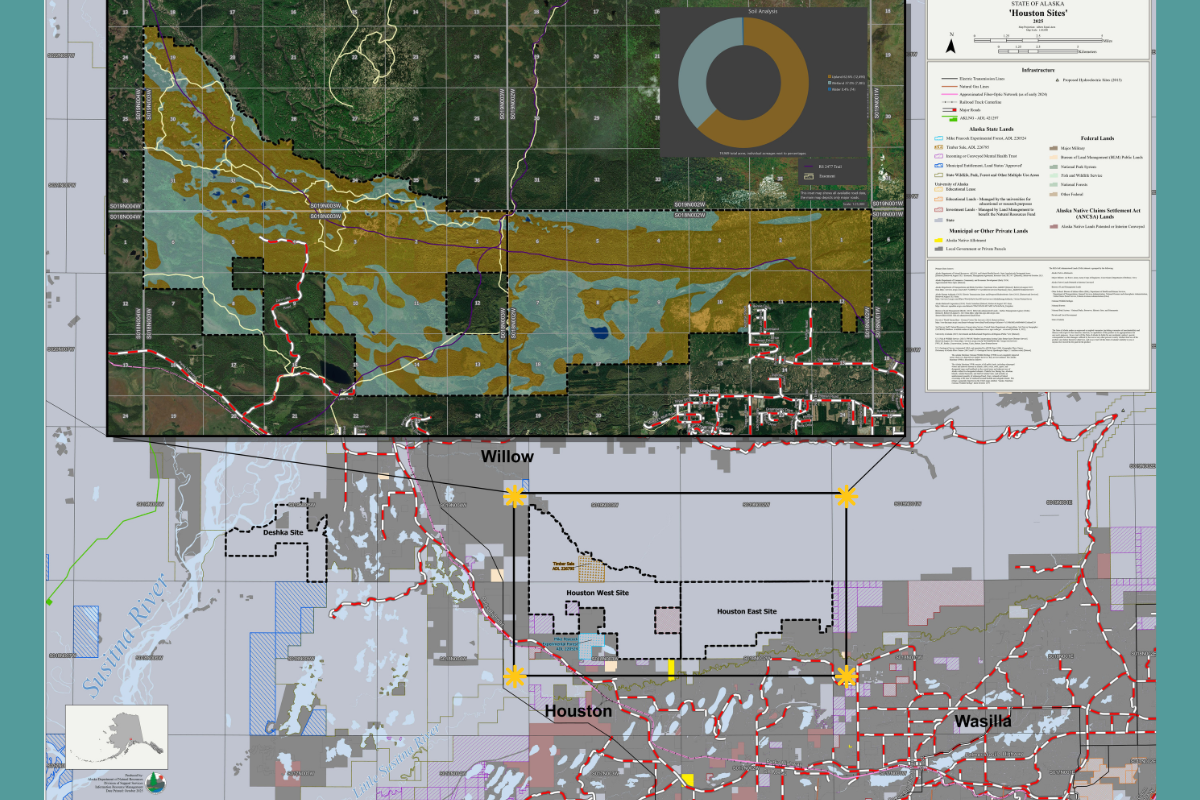
Last month, the State of Alaska’s Department of Natural Resources (DNR) announced its plan to give the Alaska Industrial Development and Export Authority (AIDEA) nearly 20,000 acres of public land near Houston, Alaska, under a “public and charitable use” provision. AIDEA, a state-owned corporation with a terrible record of wasting public funds on questionable projects, proposes to build an industrial and energy development district that could include a logistics hub, manufacturing pads, energy and utility infrastructure, data centers, and more.
The announcement was followed by a brief comment period. These are big decisions about public resources, and local communities have already made their concerns clear. The city councils of Willow, Meadow Lakes, Big Lake, and Houston have all taken up the proposal in public meetings with packed halls. While their resolutions differ in their recommendations, none has expressed full support for moving forward as proposed. In Houston, residents and city officials raised concerns about the lack of transparency and the need for DNR to slow down the process.
In response, DNR has extended the comment period to end at 5 PM on Monday, September 14. That extension is a reminder that speaking up works. You can use this commenting tool to add your concerns to the record.
DNR also announced plans to host two informational public meetings before the end of the comment period. The meeting will be held over Zoom, public comments will not be accepted during the meeting. The first will occur August 27, 2026 at 6:00 pm, the second will be held September 2, 2026, at 11:30 am. Learn more and access the Zoom links for the meetings here.
This proposal marks a bold divergence from the intention behind the public and charitable use conveyance. The public and charitable use statute allows the state to transfer land for less than its appraised value when the recipient is carrying out a qualifying public good. Historically, this provision has been used for relatively small parcels going to cities, boroughs, utilities, nonprofits, churches, fire departments, and other community-serving organizations. According to an analysis of DNR records, 94% of previous transactions were for parcels smaller than 100 acres.
Normally, the recipient pays a share of the appraised value of the land. Now, in what publicly available records suggest is the largest land transfer ever proposed under this doctrine, DNR wants to give AIDEA 19,950 acres, and DNR is proposing to waive the state’s reversionary interest, meaning the state would give up its normal ability to reclaim the property if the promised public benefit does not materialize. Once it is out of state hands, DNR says it has no role. This is a no-strings-attached giveaway with remarkably little accountability.
And as AIDEA faces pushback, their message about what they really intend to do with this land is less and less defined, creating more uncertainty about the full impacts of this land transfer.
“AIDEA’s development plan identifies possibilities, not commitments: rail-served logistics, shared utility corridors, advanced manufacturing, local material production, energy infrastructure, workforce housing and, potentially, data centers,” AIDEA officials said in an opinion column. “Listing a possible use lets the public and reviewing agencies see the range under consideration; it does not mean any of it will be built.”
But that is exactly the problem. How can we, the public, determine whether permanently giving away nearly 20,000 acres of public land is justified as a public good when there are no clear commitments about what will actually be built there? This land transfer should not move forward without DNR accounting for basic questions:
- What is this land actually worth?
- AIDEA has over a billion dollars in assets and cash. Why shouldn’t it pay fair market value for the land?
- What specific businesses or projects are committed to the site?
- How many new jobs are actually expected to be created for Alaskans?
- What will happen to public access, hunting, fishing, recreation, and wildlife habitat?
- Why is DNR giving up its ability to take the land back if the proposed development doesn’t happen?
One thing is clear: if AIDEA develops an industrial park here, there will be impacts to clean water and healthy habitat. The proposal would reclassify approximately 15,100 acres currently designated for Forestry, Habitat and Water Resources as Settlement. Some of this land is currently managed for important wildlife habitat, including moose calving, rutting, and wintering areas. DNR acknowledges that future development could affect public access, trails, water resources, fish, and wildlife habitat.
Alaska’s public lands are one of our greatest shared assets. Decisions to permanently transfer them should be made transparently, with meaningful public input and clear accountability.
If you haven’t commented yet, now is the time. DNR has given Alaskans until September 14 to speak up. Use this tool to help craft your unique comment.
Your voice helped extend this comment period. Let’s use the extra time to make sure DNR hears from the people who live here, use these lands, and will have to live with the consequences of this decision.