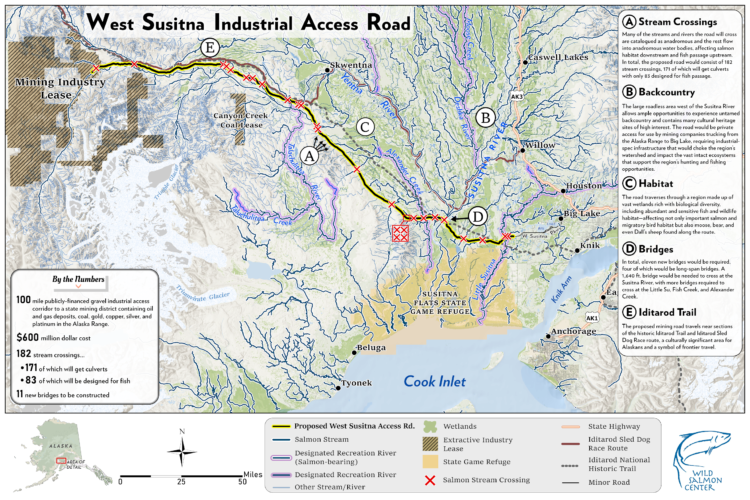
The West Susitna Access Road is a proposed 100-mile industrial road through the Susitna watershed, designed primarily to open up remote lands for large-scale mining operations by primarily foreign companies. The project is split between AIDEA, which is pursuing roughly 78 miles of the road from the west, and DOT, advancing the first 22 miles from the existing road system. Rather than being funded and permitted as one project, the project has been strategically sliced up, minimizing its impacts on paper and allowing access to more pots of public funds. This year, we have seen a growing number of taxpayer money-grabs to keep the project moving forward, even as its costs balloon and major permitting questions remain unresolved.
$47 million from the Legislature
West Su stakeholders had their eyes on the capital budget this session. Thanks to the consistent voices of concerned Alaskans, lawmakers removed $95 million originally proposed for the DOT portion of the project. Unfortunately, in the final days of the session, $47 million was put back into the capital budget, half of the original amount. The last-minute reinsertion came as lawmakers worked to assemble a capital budget that could win the Governor’s support, including critical funding for Alaska’s schools.
This politically driven compromise is disappointing, but $47 million is nowhere near enough to build the road. The funding will not cover the full first 22 miles or the Susitna River crossing, and the project still faces major permitting and environmental hurdles.
AIDEA adds another $25 million
Unlike the DOT funds allocated through the capital budget, which underwent a significant public process, Alaska Industrial Development and Export Authority (AIDEA), the publicly funded state-owned corporation, gets to push public dollars to its segment of the proposed road, with one mid-week morning board meeting vote. In August, AIDEA’s board unanimously approved another $25 million in Alaska funds for geotechnical work on its portion of the road.
AIDEA is spending tens of millions of public dollars to advance a project for which it still has not completed a permit application to the U.S. Army Corps of Engineers. The agency has approximately $1.75 billion in state funds at its disposal and has increasingly moved major projects forward without legislative oversight.
DOT is now seeking increased federal funding
The latest development comes from DOT&PF’s proposed 2027 to 2030 Statewide Transportation Improvement Program (STIP). The new draft provides insight into how quickly costs are rising for this proposed industry handout.
The projected cost of the first 22 miles has jumped from approximately $89.6 million in the previous STIP to $227.6 million in the new draft, an increase of roughly 154 percent. DOT is proposing more than $215 million in new funding for the corridor over the next four years.
The proposal also adds $17.25 million for a newly proposed Point MacKenzie Connector project, a seven-mile road connecting Point MacKenzie Road to the West Susitna Access Road. Together, these two DOT projects have a combined projected cost of approximately $244.8 million.
But this isn’t $244.8 million in free federal money. Federal transportation dollars require Alaska to contribute a share of the cost, and that state funding competes with other transportation needs. We have already seen DOT delay federally funded projects because of insufficient state match. If DOT wants to move these West Susitna projects forward, the state will have to continue putting its own money behind them. Alaskans should be asking why the state should prioritize its limited transportation dollars for a road primarily designed to serve private mining interests, sidelining road projects that actually serve our communities.
Right now, Alaskans have an opportunity to weigh in. DOT’s proposed STIP is open for public comment through October 29. Comments can help influence the final transportation plan, but they can also build an important public record for the Legislature. When legislators are later asked to approve state funding for West Susitna, they should be able to point to a clear record showing that Alaskans have serious concerns about spending scarce public dollars on this project.
We encourage you to submit a comment opposing the inclusion and expansion of West Susitna in the STIP before October 29.
A growing public subsidy
Between AIDEA’s 78 miles and DOT’s 22 miles, the West Susitna Access Road represents hundreds of millions of dollars in proposed publicly funded spending, and the latest STIP proposal shows us how quickly the costs are rising. That is a staggeringly wasteful subsidy for private resource development at a time when communities across Alaska are struggling to fund basic needs. Taken together, these developments tell a troubling story about how a massive public subsidy can happen incrementally: one appropriation, one agency, one section at a time.
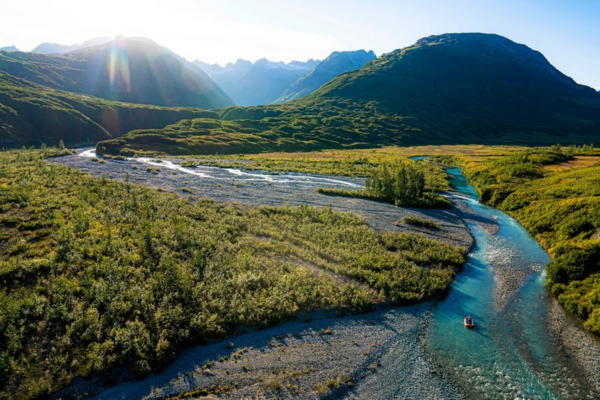
The good news is that there are plenty of hurdles before this road can make meaningful headway. Neither DOT nor AIDEA has successfully submitted applications for their major federal Clean Water Act permits, because let’s not forget: not only is the project a gross misuse of public funds, but the road would have major impacts on clean water and healthy salmon systems in South Central Alaska. The proposed road would cross 182 waterways, including at least 83 known salmon streams, and would open the door to a new mining district in some of Southcentral Alaska’s most important hunting and fishing habitat.
The Alaska State Legislature has shown interest in curbing unchecked AIDEA advances and reprioritizing DOT spending. Pending election results, the legislature will continue to be a vital body bringing some sense back to how we allocate our taxpayer dollars.
At a time when Alaska faces enormous fiscal challenges and communities are struggling to fund basic public needs, pouring hundreds of millions of public dollars into infrastructure for private mining interests is the wrong priority.
Like with most projects of this scale, the work to protect the watershed and precious public funds is a marathon. Our focus for the next mile is submitting our concerns during the open STIP comment period, and we encourage you to do so as well.
Tell DOT what you think
The proposed 2027–2030 STIP is open for public comment through October 29. Submit a comment to DOT and tell them that Alaska’s limited transportation dollars should not be used to subsidize the West Susitna Access Road.