
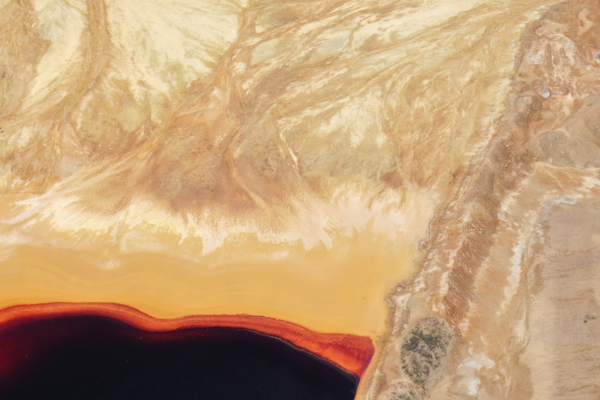
The proposed 471-foot dam would hold up to 568 million tons of mine tailings, and the federal analysis finds that a 27% release could cause loss of life, inundate the village of Crooked Creek, leaving parts uninhabitable, contaminate water, and cause Kuskokwim fish populations to decline for generations.
But the federal government still hasn’t looked at the full scope of what could happen. The largest scenario analyzed in the draft is a 27% release, even though tailings dam failures around the world have resulted in the release of 100% of the stored toxic sludge.
Now, the public has until October 23 to tell federal agencies that a 27% scenario is not enough to understand the risks facing the Kuskokwim.
If constructed, Donlin Gold would be the largest pure gold mine in the world. The project would process hundreds of millions of tons of ore and generate billions of tons of toxic waste. There is widespread opposition to the project from the communities that would live with its consequences, including a majority of Yukon-Kuskokwim Delta Tribes, who have formally opposed Donlin. This Draft SEIS exists because local Tribes took the federal government to court.
In 2023, six Yukon-Kuskokwim Delta Tribes challenged the federal approvals for Donlin Gold, arguing that the project’s environmental review failed to adequately consider the consequences of a catastrophic tailings dam failure. The original 2018 environmental impact statement considered a hypothetical release of only about 0.5% of the tailings storage facility’s capacity.
In September 2024, a federal judge sided with the tribes and ruled that the agencies had violated federal environmental law by failing to adequately consider the consequences of a larger tailings spill. In June 2025, the court ordered the Army Corps and Bureau of Land Management to prepare a supplemental environmental review. That court order is what brought us to the Draft SEIS released this September and will be the basis for the Army Corps and BLM to decide whether to modify, reaffirm, or rescind the existing federal permits.
What the DEIS found
The new analysis gives us a much clearer picture of what a large tailings failure could mean, but it falls short of analyzing the full impact. The court already rejected the agencies’ position that the consequences of a larger spill did not need to be analyzed because such a failure is unlikely, and while a 100% tailings spill is indeed unlikely, it is possible and should have been studied.
Instead, the new Draft SEIS models three partial spill scenarios: 5.4%, 13.3% and 27%. These percentages describe the amount released, not the probability that a failure will occur.
The largest modeled scenario would release approximately 109,730 acre-feet of toxic sludge. The modeled spill front would reach Crooked Creek, the nearest village of the proposed mine, in about 90 minutes. That leaves a critical question: could everyone actually be warned and evacuated to safety in that time?
The consequences are staggering and unacceptable.
Crooked Creek could become uninhabitable. Under the 27% scenario, tailings could be deposited 10 to 30 feet deep, with the village’s airstrip fully inundated. The analysis identifies impediments to evacuation, displacement and potential loss of life.
Drinking water could be compromised. Under the 27% scenario, floodwaters would enter Crooked Creek’s groundwater source protection area, while deposited tailings could continue affecting the area until cleanup. The Draft SEIS also says contaminants could continue leaching from deposited tailings for decades.
Fish impacts could last for generations. The Draft SEIS describes disruption to salmon migration, loss of multiple year-classes and changes in fish composition and production that could be generational. In Crooked Creek, it says fish populations may never return to pre-disturbance levels, even with fish reintroduction.
Subsistence would be affected in ways that go far beyond contaminated water. The analysis identifies potential damage to boats, fish wheels, smokehouses and drying racks, reduced availability of fish and wildlife, restricted access, and potential accumulation of metals in harvested animals and fish.
Cleanup would not necessarily mean restoration. Under the 27% scenario, the Draft SEIS estimates that approximately 4,812 acres of wetlands and 32 miles of streams could be affected by tailings deposition. It acknowledges that cleanup and remediation may not be feasible or effective in some areas, and that wetland functions could remain impaired for decades to a century or more.
While the consequences of the 27% scenario are already so severe, it does not communicate the full picture of what’s at stake. 100% tailings dam releases are very unlikely, but they happen. The seismically active region where the mine is planned certainly adds to the risk. Remember, this dam must stand forever.
If 27% could make Crooked Creek uninhabitable, disrupt salmon populations for generations and contaminate water for decades or longer, what would happen if substantially more material escaped? The people of the Kuskokwim deserve an answer.
Now is the time to comment. The Draft SEIS is open for public comment through October 23, 2026. You may comment online or attend a public hearing and testify
You do not have to be an engineer or environmental scientist to comment. The strongest comments can come from people explaining what clean water, salmon, subsistence, safe communities and healthy rivers mean to them.
Remember to urge the Army Corps to:
- Do their due diligence and study the consequences of a dam failure that results in 100% of Donlin’s toxic tailings being released into the Kuskokwim watershed.
- Rescind Donlin’s existing Clean Water Act permit because the consequences of even a partial spill pose too much risk to Alaska communities.
Comments may be submitted:
- Online: through the official comment form or through Mother Kuskokwim’s online action
- By email: donlingoldseis-record@aecom.com
- By mail: Donlin Gold SEIS Comments, USACE, Alaska District, Regulatory Division, P.O. Box 6898, JBER, AK 99506-0898
Virtual public hearing information:
The virtual meeting will take place on Monday, October 19, 2026, from 6:00–8:00 p.m. In-person public hearings will also be held in Crooked Creek, Aniak, Bethel.
Registration is required in advance through the official Donlin Gold SEIS website.
While the Draft SEIS is limited to analyzing the impacts of a tailings dam failure, Donlin’s broader footprint stretches all the way to Cook Inlet, with a proposed 315-mile gas pipeline connecting the Inlet to the mine site. Commenting today in opposition to Donlin is both an act of solidarity with Kuskokwim communities and an act to protect many of our home waters in the Cook Inlet watershed.