
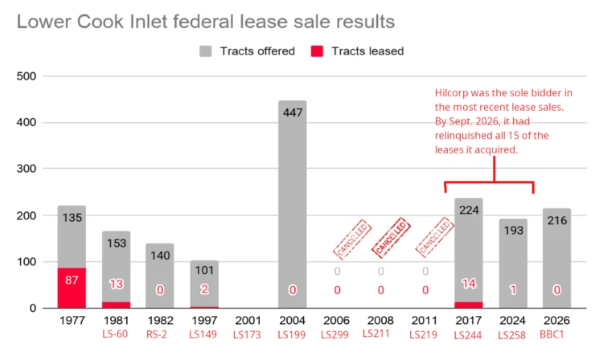
The Big Beautiful Bill that Congress passed in July 2025 was a big, un-beautiful bouquet of bad ideas. Among them: mandated oil and gas lease sales in Lower Cook Inlet nearly every spring between 2026 and 2032, excepting only 2029. While state-leased waters in upper Cook Inlet have had oil and gas extraction since the 1960s, lease sales in the federal waters of Lower Cook Inlet have generated a lot of political rhetoric but no energy. The “Big Beautiful Cook Inlet” sales have been no exception. After the Bureau of Ocean Energy Management (BOEM) cut environmental review and public input to hold the BBC1 sale in March 2026, it received zero bids.
Thanks to Congress, the charade will continue. BOEM – recently reorganized as the Marine Minerals Administration (MMA) – will hold the BBC2 sale in March 2027. Alongside the six sales mandated in the Big Beautiful Bill, the yet-to-be finalized Outer Continental Shelf Five Year Plan calls for an additional five between 2027 and 2031. The federal government is proposing to hold as many lease sales in the next seven years as have taken place since leasing began in 1977. This is an astonishing decision to throw good tax dollars after bad.
47 years of imaginary development
The last time the oil and gas industry showed any actual appetite for Lower Cook Inlet leases, Anchorage looked like this:
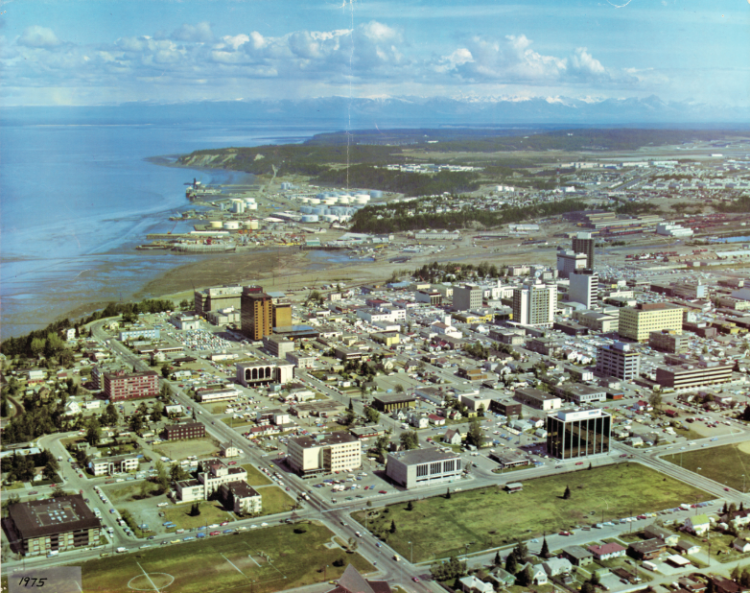
Anchorage 1975, two years before the first Lower Cook Inlet lease sale.
In October 1977, the Trans-Alaska Pipeline had been turned on for five months. Jimmy Carter was finishing his first year in office. That summer, an odd movie called Star Wars had been a surprise hit.
In the immediate wake of the Arab Oil Embargo, the new Carter administration opened 135 tracts in the federal waters of lower Cook Inlet for bidding in 1977, leasing 87 of them. It was the first federal lease sale in Cook Inlet, and the last one that could remotely be described as successful. Winning bidders drilled eight exploratory wells in their new leases, but found no commercial hydrocarbons. By 1982, all those wells were plugged and abandoned, and only 38 of the 87 leases remained active. By the time Return of the Jedi came out in 1983, Lower Cook Inlet’s mini-boom was done.
“The pace of drilling currently suggests that the initial optimism of the oil industry has been dampened,” stated a 1982 summary report by the US Geological Service. “However, the exploration results to date neither prove nor disprove the existence of hydrocarbons.” A re-offering of the second lease sale’s leftovers later that year received no bids. After the fourth sale in 1997 received two, it was clear the cost of continuing to hold auctions with few if any bidders was not justified.
Just to be sure, the agency offered its largest lower Cook Inlet lease sale in 2004, with 447 tracts on offer. No one bid.
Forty seven years later, Lower Inlet lease sales are a worn-out, counterproductive drag. Stale hopes and inflated expectations force them to grind pointlessly on, much like the Star Wars franchise.
Data from BOEM, chart by Cook Inletkeeper. Source
In the 2017 lease sale, Hilcorp placed the first Lower Cook Inlet bids in two decades, claiming 14 leases. BOEM representatives called it “the latest sign of continued industry optimism in the Trump Administration” and “another step in an America First energy strategy that puts us on our way toward energy dominance.” Senator Lisa Murkowski said it was “good news for the future of affordable energy in southcentral Alaska.”
It ended up being none of these things. Hilcorp carried out destructive seismic exploration of the leases in fall 2019, and relinquished half of them five years later. This September it gave up the rest, as well as the one lease it acquired in the 2024 lease sale. There are now once again zero active oil and gas leases in Lower Cook Inlet.
Doubling down
The past, however, doesn’t predict the future. With existing Cook Inlet gas becoming increasingly unaffordable and high-priced imported LNG set to replace it, could drilling in the Lower Cook Inlet meet our gas needs?
Everything known about the gas reserves in Lower Cook Inlet says no – at least not at prices we’d want to pay. If Hilcorp and other drillers aren’t foreseeing attractive returns on their investment in existing Inlet fields, building brand-new infrastructure for Lower Cook Inlet is an even bigger challenge to profitability. Economics goes a long way toward explaining the industry’s persistent lack of interest, and suggests it’s unlikely to change.
BOEM estimates the amount of gas that could be economically extracted from all Lower Cook Inlet reserves would meet roughly five years of South Central’s demand. This depends on the assumption that oil sustains a price of $160/barrel. Since oil and gas are produced from the same wells, an incentive to drill more oil (i.e., a higher price) means more gas is also extracted. Alaskan oil has never hit this price. Even recently, during the historic disruptions of the Ukraine and Iran wars, it peaked at $122/barrel. Realistic assumptions about oil prices mean that getting the same amount of gas from Lower Cook Inlet drilling would likely require gas prices higher than imported LNG. Aside from spill risk and habitat disruption in Lower Cook Inlet, the most we’d get for this price would be another half-decade of procrastination on actually solving our energy problem.
As the drilling industry’s interest in Lower Cook Inlet lease sales dwindled to nothing, the political noise around them only grew. 2024’s Lease Sale 258 – in which Hilcorp bought one lease that it gave up two years later – was also mandated by Congress after BOEM made the smart decision to cancel it. Last year, these empty, destructive gestures reached a new low.
The Big Beautiful Bill actively damaged Alaska’s energy security and made it harder for utilities to respond to the decline of Cook Inlet gas by repealing tax incentives for renewables. This was directly responsible for at least one investor pulling out of a shovel-ready project, the planned Puppy Dog Lake Solar Farm in Nikiski, which would have met about 12% of Homer Electric Association’s annual energy demand without gas. What the bill offered instead is the symbolic make-believe “energy development” of mandated Lower Cook Inlet lease sales. Senator Lisa Murkowski cast the decisive vote that passed it into law.
“Doubling down on failure” is a concise description of how Alaska spent the past decade limping into stagnation. From the massive public spending on AK LNG to the twice-elected Dunleavy, examples abound. Holding the five future Lower Cook Inlet sales mandated by the Big Beautiful Bill, plus the five in the Outer Continental Shelf draft plan, would not be merely “doubling down,” nor even “tripling down on failure.” I had to do some searching to find the obscure verb “decuple,” meaning to increase ten times. “Decupling down on failure” is not a real phrase, because it’s not something sane people do.