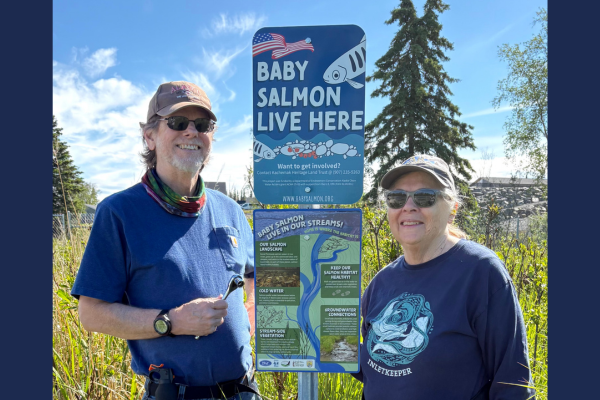
Building a Salmon Future: The People Behind Backyard Salmonscapes

Clean Water, Community Action Studio, Drawdown, Salmon

When you volunteer with Backyard Salmonscapes, you become an ambassador for your watershed. You show and inspire your neighbors, friends, and family that what we do in our backyards matters, and that every choice we make can help or harm our salmon streams.
None of these projects happen in a vacuum. Many thanks to our community partners: Kenai Watershed Forum, Kachemak Heritage Land Trust, and the Kenai Peninsula Fish Habitat Partnership.
Local solutions only work when people step up. The Backyard Salmonscapes program in the Central Peninsula is powered by volunteers who roll up their sleeves and put in the time, energy, and heart to protect the streams and wetlands our salmon call home.
 
Whether it’s posting ‘Baby Salmon Live Here’ signs on forgotten creeks, mapping salmon habitat, talking with neighbors at community events, or spreading the word, volunteers are the engine behind Backyard Salmonscapes. Their work brings people face-to-face with the waters and wetlands that salmon and our communities depend on.
 
Volunteers aren’t just checking boxes; they’re building a culture of stewardship. Every chat at a community event, every muddy hour in the field collecting data, every sign hammered in is a chance for someone to learn what salmon need to survive and thrive.
 
When you volunteer with Backyard Salmonscapes, you become an ambassador for our watershed. You show and inspire your neighbors, friends, and family that what we do in our backyards matters, and that every choice we make can help or harm our salmon streams.
 
Backyard Salmonscapes succeeds because people care enough to show up. Whether you give an afternoon or stick with us for the long haul, every bit of effort helps us understand and protect local salmon habitat for the future.
 
Volunteers are making sure future generations can fish for wild salmon, enjoy healthy habitat, and drink clean water. Their dedication proves that real conservation starts in our own communities, and that everyone has a part to play.
 
To everyone who has volunteered with Backyard Salmonscapes, thank you! Your dedication has helped shape this community-driven effort into the local conservation movement it is today. Whether you’ve spent an afternoon installing signs, mapping salmon habitat, staffing a community event, or simply sharing our mission with others, every contribution has made a meaningful difference. Because of your willingness to get involved and your commitment, Backyard Salmonscapes continues to grow, bringing people together and empowering a local conservation movement that safeguards one of the Central Peninsula’s greatest natural treasures: SALMON!
 
If you want to make a real difference right here at home, join us. Join us for the next Salmon Habitat Mapping field day on August 8. For more information, contact David Knight at david@inletkeeper.org.
 

Similar Posts

The “Big, Beautiful Cook Inlet” (BBC1): March Lease Sales Move Forward without New Environmental Reviews

Instead of conducting updated environmental analysis, on the BBC1 lease sale the administration indicated it would rely on reviews completed in 2017 during the first Trump administration. Inletkeeper has joined with community and environmental groups to formally notify Interior Secretary Doug Burgum of their intent to sue if the sale proceeds without required consultation under the Endangered Species Act (ESA). Relying on outdated reports disregards nearly a decade worth of analysis on the accelerating impacts of climate change, increased industrial activity, and updated science on species and habitat conditions.

We can’t risk turning climate pollution into water pollution

Carbon capture has a host of uncertainties upstream of the injection well. But let’s set aside for now the unsolved technological question of how CO2 can be affordably captured at any significant scale. Likewise the economic and political questions of how to price and/or police carbon to make polluters capture it. What concerns do we have about pumping CO2 underground, and the vigilance needed to be sure it doesn’t harm the people and ecosystems above?

Protecting What We Love, Building What We Need

As Homer Drawdown prepares to launch our fourth solution in the near year, we are forging ahead with a new focus: local waste streams. Roughly one-third of food is wasted globally, and likewise, organic material makes up about a third of what ends up in our local landfill.

Unexpected Life in Unmapped Waters

I’ve waded in what I consider the most beautiful waters in the world here in the Cook Inlet watershed. I’ve chased every species of salmon that call these special waters home. However, after teaming up with the Kenai Watershed Forum (KWF) for Salmon Habitat Mapping field days—a program designed to engage volunteers in documenting local, unmapped salmon habitats as part of Inletkeeper’s Local Solutions series—I can now say that fish also live in unexpected places.