
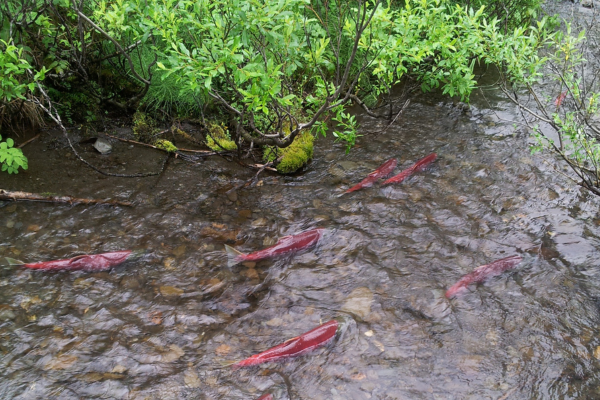
Alaska’s wild salmon depend on clean, cold water. A statement so obvious it feels trite to write, yet ensuring that enough water remains in rivers and streams for salmon to spawn, rear, and migrate is becoming increasingly important—and increasingly challenging.
Fortunately, Alaska has a tool designed to do exactly that: instream flow reservations.
An instream flow reservation allows water to remain in a river, stream, or lake to support fish habitat and other public values. Rather than allocating every drop for industrial, commercial, or other uses, instream flow reservations help ensure that salmon and the ecosystems they depend on have enough water to survive.
Current regulations favor industry- mandating that if a company wants to take water from a stream, it can apply for a water right and ask the state to determine whether that use is in the public interest. But if Alaskans want to protect water for salmon, they face a much higher bar. Applicants—often in these cases being Tribes, watershed groups, conservation organizations, and community members- seeking an instream flow reservation must often conduct extensive studies, collect years of data, and navigate a lengthy regulatory process before water can be legally protected for fish.
That imbalance doesn’t make sense.
If a proposed withdrawal could reduce stream flows needed by salmon, the responsibility to demonstrate that fish habitat will not be harmed should rest with the applicant seeking to take the water—not with members of the public working to keep water in the stream.
This is especially important as Alaska faces increasing pressure from the cumulative impacts of development and a changing climate. As stream temperatures rise and fish habitat becomes more vulnerable, we need policies that make it easier—not harder—to protect the cold, flowing water salmon require.
There is a simple fix: streamline and strengthen the instream flow reservation process so that communities can protect important salmon streams without spending years and significant financial resources proving what we already know—salmon need water.
Unfortunately, this conversation is not just theoretical.
The Alaska Department of Natural Resources is currently considering changes to the state’s instream flow reservation regulations that will make it increasingly difficult to reserve water for fish. While DNR says the changes are intended to make the process more efficient, many of the proposed revisions would actually make it more difficult and expensive for Alaskans, Tribes, watershed groups, and conservation organizations to protect water for fish.
Among other changes, applicants could be required to collect additional years of data and conduct more extensive analyses before securing an instream flow reservation. The proposal would also shift control of approved reservations away from successful applicants and allow additional costs associated with reviewing and maintaining reservations to be passed on to those seeking to protect fish habitat.
At a time when climate change is putting increasing pressure on Alaska’s salmon streams, we should be reducing barriers to protecting water—not creating new ones.
The current system already asks everyday Alaskans to shoulder much of the burden of protecting fish habitat. Rather than making that burden heavier, state policymakers should be looking for ways to streamline the process and ensure that those seeking to remove water from fish streams bear the responsibility for demonstrating that their actions will not cause undue harm to salmon habitat. Revisions to this policy could be a good thing if they were used to improve protections for salmon, wildlife, recreation, and public use.
The Alaska Department of Natural Resources is accepting public comments on the proposed regulations through Tuesday, June 30. This is an important opportunity for Alaskans to speak up for healthy salmon streams and a fair water management system.
Alaska’s salmon support communities, jobs, subsistence traditions, and local economies across the state. Protecting the water they depend on should remain a public priority.
To submit your comment, see the directions below. Please note that questions on the proposed regulations must be submitted by June 20, 2026, at 5:00 PM.
Online comment portal:
https://dnr.alaska.gov/mlw/comment/submit/?topic=water_inflow
Email:
dnr.water.regulation@alaska.gov
Mail:
Alaska Department of Natural Resources
Division of Mining, Land & Water
Program Support Section
Attn: Brandon McCutcheon
550 W. 7th Avenue, Suite 1070
Anchorage, AK 99501-3579
Questions may be sent to:
dnr.water.regulation@alaska.gov
For accommodations, contact Brandon McCutcheon by June 20, 2026, at dnr.water.regulation@alaska.gov or 907-269-8511.
Key concerns to consider for your comments:
- Wild salmon need sufficient water to spawn, rear, and migrate.
- Scientists predict that air and stream temperatures will continue to rise across the state, altering the cold-water flows salmon need to thrive.
- The current process to reserve water in fish streams is time-consuming and expensive, and a simple fix can save money while protecting our wild salmon.
- The burden of protecting water for fish should fall on the company that wants to take water from a fish stream, not on everyday Alaskans who want to ensure healthy salmon runs for years to come.
Want to learn more? Our friends at Susitna River Coalition hosted Michael Lilly of Geo-Watersheds Scientific for a 45-minute webinar on water reservations in Alaska. This recording provides useful background on how water reservations work and why they are an important tool for protecting instream flows for salmon, wildlife, and public use.
Watch the webinar: https://www.youtube.com/watch?v=Y7CRm8ao5u8