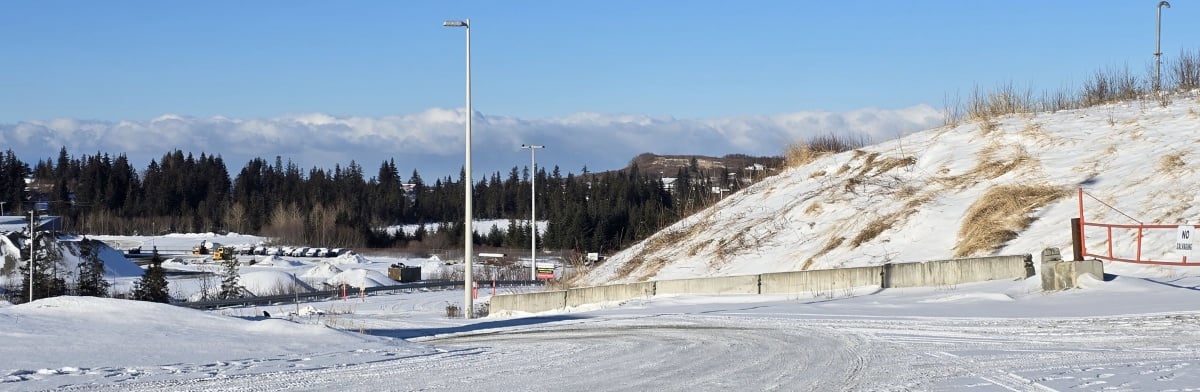
You may have noticed some changes at the Homer Transfer Facility recently. Thanks to the initiative of our local volunteers, together with the expertise of facility staff and borough employees, changes proposed by Homer Drawdown are being realized.
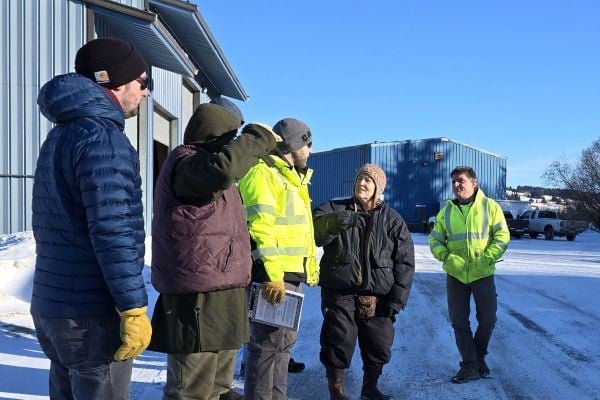
Several possible improvements began to take shape after a frigid March tour of the facility and a fruitful consultation with Kenai Peninsula Solid Waste Operations Manager, Eric Lervig, and former Facility Manager Jim Norcross. In the welcome June sun, the staff of the Homer Transfer Facility has implemented the first of these proposed changes. Visitors will notice that several recycling bins have been moved out of the large garage structure, making that covered space available to be used as a larger reuse area.
This is a clear benefit to the entire community. With more space available, the reuse area will no longer need to be emptied into the landfill several times a day, saving the time and effort of transfer facility staff. Because the space will not need to be cleared as often, residents will have more time to pick up these items. Everything that can be salvaged represents a longer lifespan for our landfill.
It is impossible to predict exactly, but borough staff estimate that the construction and demolition (CD) cell at the Homer landfill will be full in three to five years. Once the cell is full, all that bulky material will need to be hauled up to the Central Peninsula Landfill at substantial financial and environmental cost; in addition to the damage those extra trucks might cause to our highway system. As costs rise, residents are likely to see new fees being charged for the disposal of everything, including household waste.
The CD cell is the only active landfill cell at the Homer facility. It does not have a protective liner or vent infrastructure like those designed for a household waste cell. To protect our watershed from hazardous runoff, it is absolutely critical that only inert material is landfilled there. As volunteers are sorting through the debris pile, they are able to separate scrap metal and household waste which the public has failed to sort from CD material as well.
While it may not be the most beautiful feature of the Homer area, the transfer facility is certainly one of the most critical. Homer would not be the breathtaking environment we all value for its abundant food, wildlife, and natural spaces without an appropriate system for disposing of our trash. Our community would not have become the vacation destination that it is now without a functioning transfer facility. We all utilize its services, and we are all invested in this critical waste management infrastructure.
A community is nothing without its residents, and infrastructure would not function without its staff and managers. We are fortunate to have borough employees like Eric Lervig who have years of experience and a genuine concern for proper waste management. The former Homer Facility Manager, Jim Norcross, has overseen operations for decades with a serious eye; his insight and experience has benefitted the community long before this project began. John Dudley is taking over a crucial and difficult job as the current Facility Manager.
Facility staff do a job that few of us would volunteer to do, so please give them your respect, a friendly wave, or maybe a box of donuts when you stop by.
Homer Drawdown is a grassroots volunteer organization supported by Cook Inletkeeper. Whatever we achieve together is a credit to the volunteers themselves. If you visit the transfer facility on Saturday, you might see a couple friendly faces in hi-vis safety vests diverting usable material from the CD cell. Give our volunteers a wave, and do them the courtesy of separating your household waste and scrap metal from your other material when you’re dropping off.
Ready to get involved? Contact aaron@inletkeeper.org to volunteer, or for more information about Homer Drawdown.