
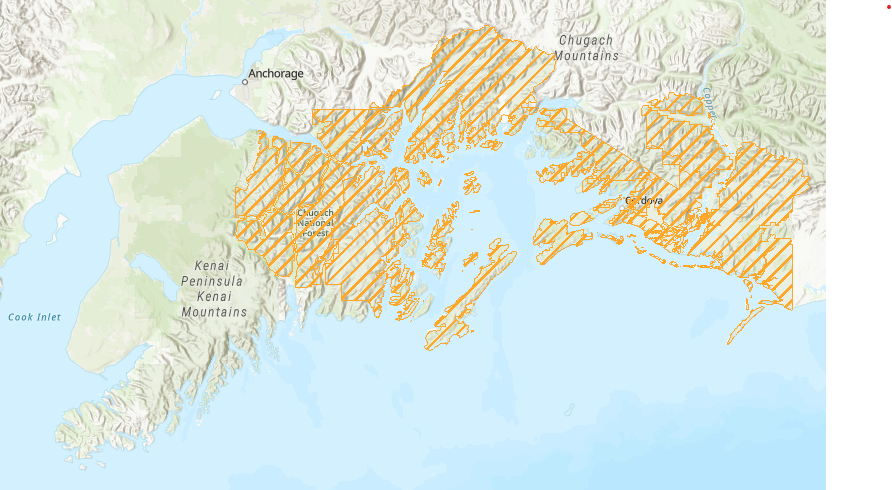
In 2001, the US Department of Agriculture instituted the Roadless Area Conservation Rule, which protected nearly 60 million acres from road construction and timber harvesting across the US. Some of our most important intact forests were designated as Inventoried Roadless Areas (IRAs) under the rule, including the Chugach and Tongass National Forests. This summer, the US Department of Agriculture (USDA) announced their intention to remove the roadless rule entirely.
The USDA voiced frustrations with the Roadless Rule in a recent press release announcing their intentions, “[this] one-size-fits-all restriction has frustrated land managers and served as a barrier to wildfire risk reduction work across large swaths of America’s national forests.” US Agriculture Secretary Brooke Rollins agreed, “For too long, outdated restrictions have kept tens of millions of forested acres off-limits to the very treatments that improve forest health and reduce wildfire risk to our communities.” Rollins’ assertion rings hollow, however, given the substantial body of peer-reviewed science which directly contradicts these claims.
A 2026 analysis showed, “Building roads into IRAs will degrade these forest ecosystem functions, increase fire risk, and is grossly uneconomic, especially given the Forest Service’s current $10.8 billion backlog in deferred maintenance. … A century of intensive logging resulted in over 386,000 miles of roads built on US national forests, enough to circle the globe about 15 times. This massive road system contributes to reductions in the quality and quantity of water, habitat fragmentation, spread of invasive plants, increased wildfire risk, and other problems that undermine ecological integrity.”
Logan Berner, a forest ecologist at the University of Alaska Southeast, highlighted the relationship between roads and wildfires in an interview with Alaska Public Media. “Something like 85 percent or more of the wildfire ignitions that occur within the country occur adjacent to roads,” Berner said. Recent US Forest Service data shows the same correlation, finding that between 1992 and 2024, The highest wildfire-ignition density was in lands within 50 meters of roads.
Many rigorous studies illustrate the fact that intact forests represent a natural landscape condition with high value for mitigating climate change and stemming the loss of biodiversity, while providing critical sources of clean drinking water to society. Research clearly shows that intact wilderness areas halve the extinction risk of terrestrial biodiversity. The relationship between unfragmented forests and watershed health is clearly established as well.
The scientific consensus is overwhelming: undeveloped natural forests are anchors of biodiversity networks and human societies. The USDA has issued a Notice of Proposed Rulemaking to rescind roadless protections despite a mountain of data, and loud objections from scientists and Indigenous communities.
When the Forest Service surveyed Native communities in 2019, they voiced nearly unanimous support for the Roadless Rule. Since then, Indigenous youth in Southeast Alaska have created the Sustainable Southeast Partnership with a broad coalition of partners. Their mission is to unite diverse skills and perspectives to strengthen cultural, ecological, and economic resilience. Their strength-through-diversity approach is the same dynamic which underpins healthy forest ecosystems and their associated watersheds. The Sustainable Southeast Partnership is working together with regional communities to heal and re-forest habitats that have been decimated by logging.
The US Forest Service claims to be, “committed to integrating the cultural heritage and traditional indigenous knowledge of Alaska Natives into the Tongass National Forest’s programs and processes.” Rescinding the Roadless Rule completely contradicts that commitment. Once roads are built into these undeveloped areas, a true commitment to Indigenous land management over generations will be required to regain what we have lost.
As the US Forest Service is already facing billions of dollars in deferred maintenance, it is unclear whether they even have the resources to build new roads into the protected areas that remain. Deregulation can only benefit extractive industries that require road access, at the expense of local communities and the functioning heart and lungs of our world.
Public comments on the proposed removal of the Roadless Rule will be accepted until September 21st. For more information and to file a comment, visit Regulations.gov.