
The Railbelt has a real and urgent need for energy solutions. Ideally, decision makers would meet this need by taking a comprehensive look at our region’s energy prospects and giving serious consideration to wind and solar power opportunities. Unfortunately, most are instead chasing megaproject boondoggles.
Alaska LNG is, of course, Exhibit A. But another fantasy project gives AK LNG a serious challenge as Alaska’s worst energy idea: the Terra Energy Center, a planned coal mine and power plant far from any existing energy infrastructure, with nearly twice the capacity of our entire electricity market and a dubious plan for carbon capture and storage.
Canyon Creek coal
The story starts in 2015, when the Alaska Department of Natural Resources (DNR) awarded a lease on the west Sustitna’s Canyon Creek coal deposit, about 18 miles southwest of Skwentna. Cook Inletkeeper was one of several groups joining an unsuccessful appeal against the lease sale. The winner of the lease was a company that would later take the name Flatlands Energy Corporation.
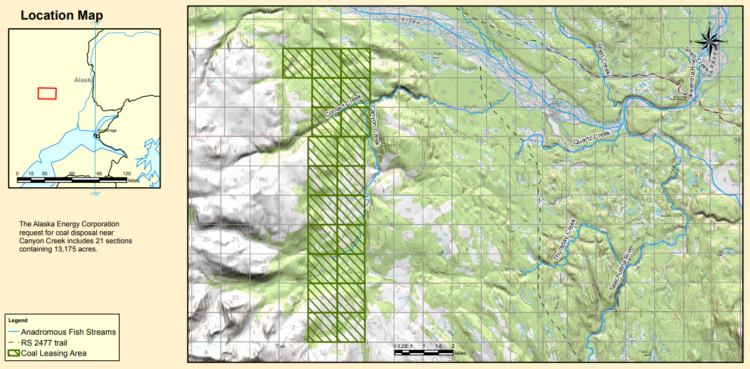
DNR’s map of the Canyon Creek coal lease area, showing anadromous streams (Contact Creek and Canyon Creek) running through the green-shaded lease. The region drains into the Susitna via the Skwentna River, and ultimately into Cook Inlet. From DNR’s 2013 lease sale findings documentation.
In 2010, world coal demand was widely expected to boom, led by growth in Asia. Developers eyed Alaska’s coal deposits for export across the Pacific. The Chuitna coal strip mine proposed for the west side of Cook Inlet would have exported coal to Asia via an export terminal looming over Tyonek, roughly 50 miles southwest of the Canyon Creek deposit. In addition to moving Chuitna coal, this terminal could have potentially given Canyon Creek coal a path to market, according to DNR’s best interest findings for the lease sale. Riding on the infrastructure built for the larger project may have been its best path. Ground Truth Trekking speculated that “the Canyon Creek project may only be viable if the Chuitna proposal actually becomes a mine.”
The market for coal exports to Asia did not grow as expected, and by the late 2010s, coal companies that had made big investments in export were struggling or bankrupt. After the Chuitna coal project failed to attract investors, it gave up its permitting efforts in March 2017.
Flatlands Energy has held on to the isolated Canyon Creek coal lease and continued searching for ways to monetize it. Their best opportunity now seems to be hitching their project to two energy trends of the 2020s: carbon capture and data center load growth.
Terra Energy Center
Midway through the Biden administration, carbon sequestration was having a moment in the spotlight. The passage of the federal Inflation Reduction Act in August 2022 significantly boosted “45Q” tax credits for industries that could capture CO2 waste from their exhaust streams and inject it into the ground – called carbon capture and geological sequestration – from $17 to $85 per ton of CO2. The next year, Gov. Mike Dunleavy was touting carbon sequestration as a get-out-of-deficit-free revenue source that could cure Alaska’s fiscal problems without raising taxes. He introduced a successful bill that laid a foundation for Alaska to regulate and collect state royalties on CO2 injection.
Inletkeeper has concerns about the potential groundwater hazards of injected CO2 and opposes Alaska’s efforts to regulate it in lieu of the federal EPA. If we are truly concerned about the carbon emissions of coal, there’s a guaranteed and extremely cost-effective way of sequestering it: keep it where it is, underground already, and build renewable energy instead.
In February 2024, the University of Alaska released a feasibility study for a mine-mouth power plant at the Canyon Creek lease that would pipe its captured carbon emissions south, to be injected for storage in depleted gas fields in northwest Cook Inlet. In July of that year, Flatlands Energy would name this proposed coal powerplant the Terra Energy Center.
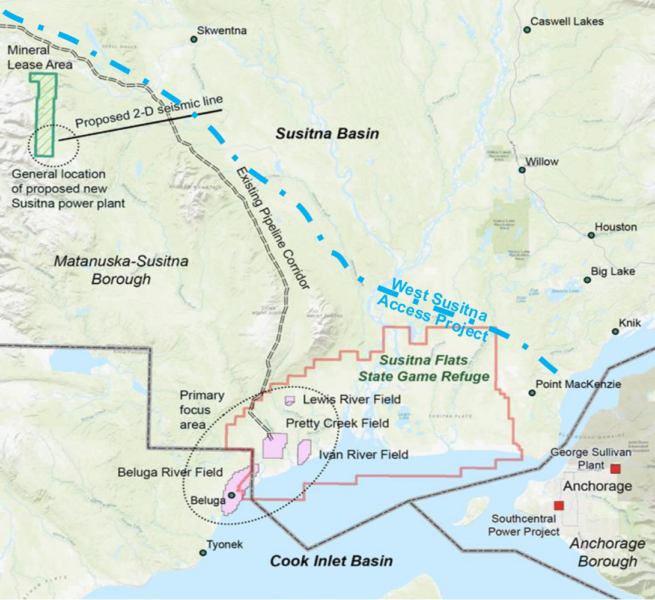
The Terra Energy Center is planned for the southern part of the green-shaded Canyon Creek coal lease in the upper left. Terra is planning to capture CO2 waste from its powerplant exhaust stream and send it south via a CO2 pipeline that would share the right-of-way of the planned natural gas pipeline to the Donlin Gold mine (the double-dashed line). The CO2 waste would be injected into depleted oil and gas fields such as Pretty Creek, Ivan River, and Beluga (outlined in pink) for indefinite storage underground. From COOK INLET REGION LOW CARBON POWER GENERATION WITH CARBON CAPTURE, TRANSPORT, AND STORAGE FEASIBILITY STUDY, 2024.
In addition to unrealistic optimism about the cost efficiency of carbon capture, the feasibility study makes big assumptions about who will pay to solve the project’s access problems – namely, it assumes the public would significantly cover the cost of the roughly 75 miles of transmission line needed to connect it to the Railbelt energy system, and for the access road to reach it. While UAF estimates the plant’s power would cost about 7 cents per kilowatt-hour with these subsidies, independent analyst Erin McKittrick estimated that 15 cents/kWh, including the road and transmission cost, is a more realistic estimate. For a construction route, the project relies on the controversial West Su Access Road, which we’ll examine further below.
The study that cut corners to justify this destructive private project was carried out by a UAF project substantially funded by federal dollars. Flatlands Energy, its main beneficiary, pitched in $68,736 alongside a $384,000 federal subgrant to UAF. More recently, the Mat-Su borough is jumping on the bandwagon to provide free marketing for a scaled-up version of the project.
As conceived in the Feb. ’24 feasibility study, the Terra Energy Center would have 400 megawatts of capacity, with a quarter of that used by its carbon capture process. The Railbelt electrical grid has a monthly peak load of 700-900 megawatts, so Terra would have provided a substantial portion of generation. But a March announcement showed that Terra Energy Center has drastically scaled up its plans. It’s now planning to build a 1.25-gigawatt power plant, far exceeding the current electricity market.
In March, the Mat-Su Borough Assembly passed a resolution dedicating borough staff time and other resources to working with Terra Energy Center to sell the borough as a location for high-power-consuming industries such as data centers and manufacturers. They set aside four areas of borough-owned land to lease to whatever industry might be enticed to an area with precarious energy affordability by the promise of power from a remote, unpermitted, and speculative coal plant.
Under the coal-fixated Trump administration, the federal government’s gifts to Flatlands Energy have also gone far beyond contributing to its dubious carbon storage claims. In March, the federal Energy Dominance Council brought them to an “Indo-Pacific Energy Security Summit” in Tokyo. It later announced that South Korea’s Hyundai Heavy Industries had made an “agreement in principle” to supply boilers to the Terra Energy Center, in addition to a $500 million equity investment from a South Korean firm. On top of this, the Trump administration in June gave Terra a $89 million Department of Energy grant.
It’s clear that public funding has been an enormous benefit to Flatlands Energy, a company that made a small-but-risky bet on a coal lease a decade ago. But it’s far from clear that Alaskans have anything to gain except damage to our watershed and climate – or more likely, simply a waste of attention and resources that should be going to viable renewable energy solutions.
Entanglements
The Terra Energy Center isn’t simply one bad idea in isolation. It’s entangled with a collection of other destructive projects in the West Su valley, all similarly constrained by lack of access and logistical challenges. Progress toward one of these bad ideas creates momentum in the eyes of investors for the others – or, should any actually be built, physical infrastructure that would help others be realized.
However little sense the Terra Energy Center makes on its own merits, its CO2 pipeline, access road requirements, and carbon sequestration elements are symbiotic with other projects.
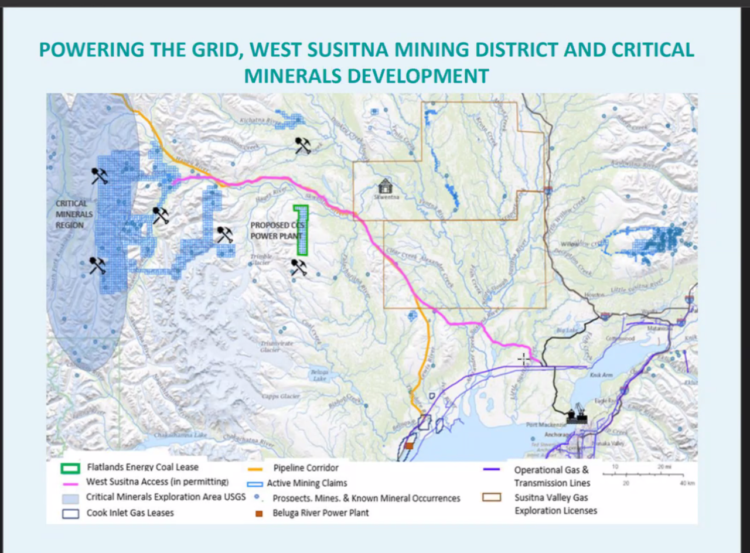
The Canyon Creek coal lease (green block) is surrounded by other prospective mining sites in the West Susitna Valley (blue blocks). All would need a transportation route for construction and shipping. The state is planning to provide them one with the expensive and controversial West Susitna Access Road (pink line). In addition, a natural gas pipeline (gold line) is planned to run through the region, going west to serve the proposed Donlin gold mine in the Kuskokwim region.
The route Terra Energy plans to use for its CO2 pipeline would be the same as the one the Donlin gold mine, in the Kuskokwim region, plans to use for its natural gas pipeline. And while it may be prohibitively expensive to build the dozens of miles of remote transmission line needed to connect Terra Energy to the region’s population centers, powering some of the surrounding mine prospects may be more profitable. In fact, the project is financially connected to the nearby Estelle gold mine, whose parent company, Nova Minerals, also owns a stake in Terra Energy’s parent company.
All the West Su projects share one very expensive need: an access road. And they want us to pay for it. Somehow, these corporate-industrial players have succeeded in lobbying the Governor into championing the road. Dunleavy’s push for the proposed 100+ mile industrial access corridor to be built entirely on the taxpayer dime has been a cornerstone of his tenure. And although many legislators remain critical of diverting public dollars to serve private industry at a time when schools are closing and vital transportation roads are crumbling, the Alaska Department of Transportation was granted $47 million for early construction and continued surveying for the first section of the road. The good news is this expensive road is still vastly underfunded. $47 million is a tiny fraction of what they will need for the full road. At this point, these funds won’t cover the first 22 miles of the road or cross the Susitna River. They have a long way to go, including permitting.
In short, the Terra Energy Project serves the extraction industry’s interests while pretending to meet our moment of energy precarity. We don’t have time to waste with false solutions.