
The proposed Johnson Tract Mine would industrialize one of the last undeveloped pockets of Cook Inlet | Tikahtnu, spurring an onslaught of traffic from military-sized planes, ore-hauling trucks, and barges through the park daily. We know that this, alongside the acid-generating rock and heavy metals the mine would unearth, will have devastating impacts on the wildlife, people, and local economies that depend on Lake Clark’s landscapes remaining a healthy, abundant ecosystem. Most folks intuitively agree this is not the future we want for the public lands we’ve set aside to protect, but experiencing Lake Clark National Park firsthand strengthens that conviction.
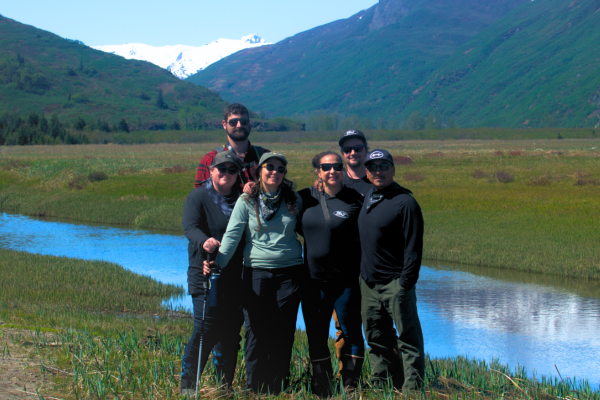
An early summer trip to Silver Salmon Creek Lodge filled the cups of our small but mighty Inletkeeper team. The lodge, a multigenerational, family-owned bear-viewing lodge, offers tourists from near and far the opportunity to safely experience Cook Inlet’s wild bear coast in Lake Clark National Park. Our team was more than grateful to have that opportunity ourselves, and our experience emboldened our commitment to fight the Johnson Tract Mine.
While exploring the landscape from the air and on the ground, we saw where the Johnson Tract Mine site would be located at the headwaters of the Johnson River, a stunning valley bordered by uplifting peaks that make way for Mt. Iliamna and the glacier moraines and turquoise lakes that pour down its slopes to feed the river.
The haul road would extend partially down the valley, then cut northeast through beautiful yet very rugged, difficult terrain to reach Tuxedni Bay, where the industrial port would be constructed in critical beluga whale habitat. The proposed port site sits directly across a very narrow channel between the mainland and Chisik Island. Chisik and its neighbor to the east, Duck Island, are an Alaska Maritime National Wildlife Refuge, and home to the largest seabird rookery in Cook Inlet. These are the lands and waters that barges, ore trucks, and heavy machinery would invade.
Yet what struck us most was not the proposed infrastructure, but what already exists there. We saw that Chisik and Tuxedni Bay are scattered with family fish camps and cabins. Another ecotourism business, Snug Harbor Outpost, once a historic cannery for Cook Inlet’s fisheries and still owned by the same family, sits on the south end of Chisik. They take guests to see the bears that den up by the mine site, but head to the coast every summer to eat sedge grass, clams, and salmon in Tuxedni Bay. We saw Tuxedni Bay’s peaceful waters, where endangered Cook Inlet belugas feed and take refuge throughout the winter, and understood why they do.
Around the corner on the ground where Silver Salmon Creek and Homestead Lodges sit, just past the mouth of the Johnson River, we explored the coastal landscape looking for bears with our guide. We learned that it’s mating season, and that the female brown bears experience delayed gestation; a pregnancy will only be initiated if she puts on enough weight by the fall. Luckily for the bears, this coastline provides an abundance of food, which is why it is home to one of the densest brown bear populations in the world. We saw bears eating sedge grasses, and felt the welling of excitement and cautious respect as we observed so closely.
We drank the clean, crisp water at Silver Salmon Lodge, and we listened to their fears about the mine contaminating their drinking source and driving the bears away or eroding the delicate trust they’ve spent decades building. Their fears are valid; contamination from mining, including acid mine drainage and heavy metals, can persist long after closure. These contaminants move through the watershed and food web, impacting both ecosystems and human health. Man camps, bear guns, and loud, heavy machinery will shift the regional bear-human relationship, making bears less predictable and less safe. Ultimately, the livelihoods of the operators at lodges like Silver Salmon and Snug Harbor depend on tourism, and tourism depends on clean water, intact wildlife habitat, and a reputation for wilderness.
We left Lake Clark with a deeper understanding of what is at stake. The Johnson Tract Mine is often discussed in terms of permits, infrastructure, and economics, but on the ground, those abstractions become real places, real livelihoods, and real wildlife. They become the bears feeding along the coast, the belugas seeking refuge in Tuxedni Bay, the families who have stewarded fish camps and tourism businesses for generations, and the clean water that sustains them all. Some places are simply too valuable to industrialize. Lake Clark’s wild coast is one of them, and we remain committed to ensuring it remains a thriving, abundant landscape for generations to come.
We believe if we take care of the land, the land will continue to take care of us, as it has for millennia. You can help take care of the Johnson River Valley and Tuxedni Bay in Lake Clark National Park, and all those who depend on them, by taking action and learning more at https://nojohnsontract.org/take-action/.