
Since late March, Alaska LNG has been the subject of almost daily hearings in the House and Senate Resource committees. The proponents — the state-owned Alaska Gasline Development Corporation and the private Glenfarne — have paraded wild timelines and given mixed messages on how much they actually need a 90% tax break proposed by Gov. Mike Dunleavy. The Department of Revenue has presented many economic models for other tax rates brought forward by legislators. But all this information only obscures the fact that what’s most essential is still missing. What will the project cost, and what does it imply for gas costs?
In late 2025 Glenfarne commissioned an engineering study (a.k.a Front End Engineering and Design, or FEED study) to rigorously estimate the cost of AK LNG Phase 1, the plan to deliver gas for in-state markets via a massively oversized 42″ pipeline without an export terminal or processing plant. They will not share this estimate with decision makers or the public whom they are asking to subsidize the project. Lacking real information, the Department of Revenue has looked at the possibilities and shown, unsurprisingly, that building an 800 mile pipeline with roughly 16 times the capacity needed for Alaskan gas consumers would be an economic disaster. Only in Phase 2 — when the addition of an LNG export terminal in Nikiski allows most of the massive capital cost burden to be shifted to hypothetical gas buyers in Asia — does AK LNG have any chance of beating today’s already high gas prices.
But while we’ve seen enough to know Phase I won’t work on its own, we don’t have the information to be confident that Phase II can even exist. Nor does Glenfarne. In an April 14 Senate Resources Committee hearing, AGDC’s Matt Kissinger said the project doesn’t plan to commission a Phase II FEED study until mid-year, and to have the estimate in early 2027 — though it also intends to start building the Phase I pipeline in 2026. Taking the timeline at face value, Glenfarne’s apparent plan to build Phase 1 without having a rigorous cost estimate for Phase II means betting the Railbelt’s energy affordability on a known unknown. Because Phase 1 does not deliver affordable energy.
Phase 1 gas cost
Understanding the Department of Revenue’s range of Phase 1 gas costs requires the context of today’s Cook Inlet gas prices, as well as projected prices for imported LNG. These gas costs, like those elsewhere in this article, are given in dollars per thousand cubic feet of gas (abbreviated “$/Mcf” — the “M” is a Roman numeral).
- Prevailing prices for Cook Inlet gas are hovering around $9
- Some gas contracts are presently delivering for around $13
- Consultants for the utilities have previously estimated imported LNG in the range of $13-$15.
- The Alaska Department of Revenue recently estimated imported LNG to cost about $17.
The very cheapest gas AK LNG Phase 1 could deliver to Alaska would match the high end of imported LNG costs – $17.42. This would be possible with the 90% tax break proposed by Gov. Dunleavy, construction cost of only $11.6 billion, and gas sold by the North Slope drillers at the low price of $1. We don’t even know if a construction cost of $11.6 billion is possible – Department of Revenue’s baseline scenario comes from an old estimate rather than the rigorous one that Glenfarne is keeping secret. If the real number is any higher, gas prices head quickly toward ruinous heights.
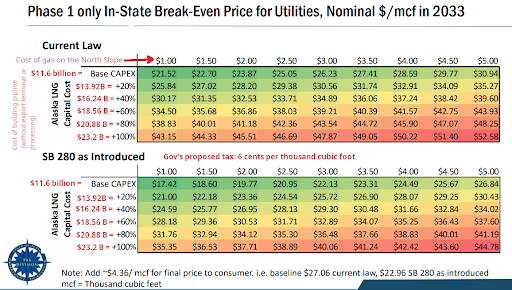
The plan for the phased LNG project amounts to jumping down a hole and hoping that the Asian gas market throws us a rope. And nobody has a good idea of how many tens of billions of dollars that rope — that is, the Phase 2 export project — will cost.
The gamble on Phase 2
Glenfarne has said that it plans to expand the project to Phase II, with the addition of export infrastructure, by 2031. This depends on long-term contracts to sell gas to Asia. The Department of Revenue also modeled possible break-even prices for that exported LNG, producing a similar matrix based on Phase II capital costs and upstream gas costs. The consultants Gaffney Cline compared this to the 10 year average cost of LNG that Asian utilities are accustomed to paying.
Here’s that analysis of the “Zone of Profitability” (red box), where AK LNG gas can beat the 10-year average. As I originally wrote in April, the Zone is obviously not big. But if AK LNG’s real capital cost (which Glenfarne hasn’t even started to rigorously estimate) exceeds the $50 billion to $60 billion that some independent analysts think likely, it may need an extreme tax break to exist at all.
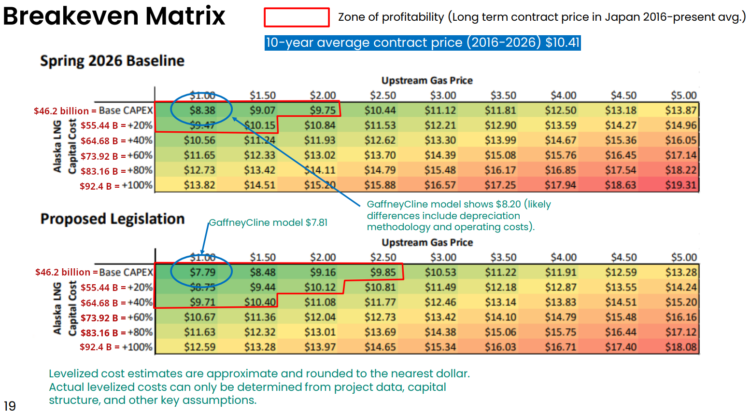
If prices can’t land inside the red box, Asian utilities won’t see much upside in shifting most of AK LNG’s huge capital cost to their ratepayers via long term gas contracts. In that case, Alaskans will be stuck with the prices coming from Phase 1.
Conclusion
Legislators have seen many, many numbers related to possible tax structures for AK LNG. But they have yet to see any numbers demonstrating that the project makes any kind of fundamental sense. They should have seen enough, though, to understand the very long odds on AK LNG ever lowering Alaskans’ energy bills, and the risk that it will dramatically increase them.
For all the attention given to AK LNG, renewable possibilities for the Railbelt remain woefully underexamined. As I wrote in 2023, when the Railbelt utilities had just started taking the gas crisis seriously, we are dealing with the problem with one eye closed and one hand tied behind our back. Since then, not only AK LNG but options for expanded Cook Inlet drilling and imported LNG have been examined. And what we’ve seen in years of analysis, of AK LNG and other options, is that all of our options for maintaining our gas reliance are worse than what we have today. Gas means higher energy bills. It’s past time to open the other eye and give renewable energy the kind of attention that this legislature has given AK LNG.