Pundits and politicos have been talking nonstop about Alaska LNG, the proposed 800-mile pipeline from North Slope gas fields to a liquefaction and export terminal in Nikiski. In Juneau, legislative committees have held months of hearings on pricing and revenue models for various iterations of a tax-break bill for the megaproject. The ADN has published articles or op-eds on the project nearly every day. But one issue that matters most to Inletkeeper’s mission is one that has gotten comparatively little attention: Alaska LNG’s impacts on Cook Inlet | Tikahtnu and its endangered beluga population.
Cook Inlet beluga populations have declined from about 1,300 in the 1970s to the low 300s today. Even after hunting stopped in the ’90s, beluga numbers have failed to recover, and there isn’t a single cause to blame. The greatest obstacle to recovery is what scientists call the “cumulative impact” of human activity in the Inlet. Major contributors are ship traffic and offshore construction, both of which AK LNG would greatly increase.
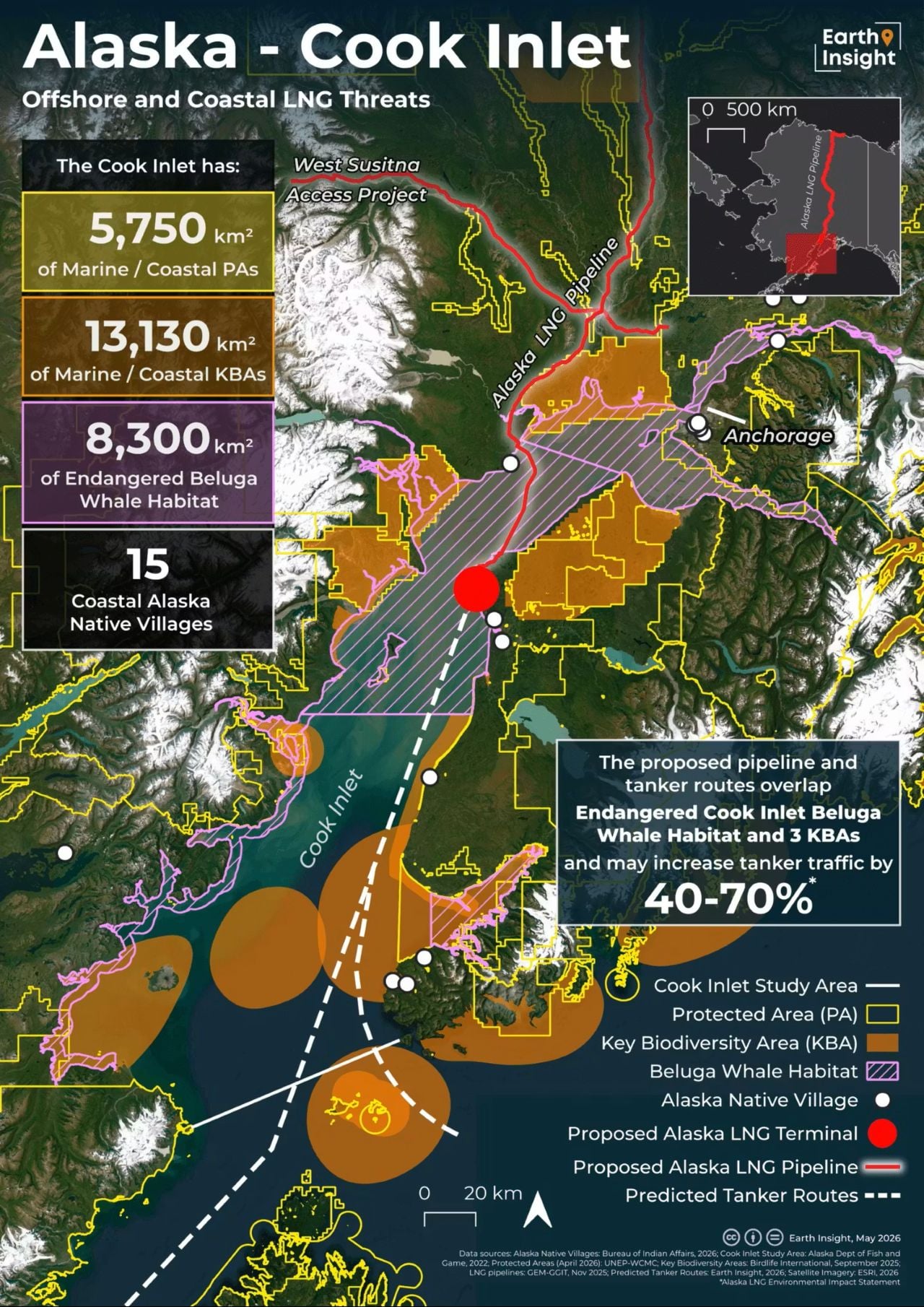
Inletkeeper recently partnered with the international group Earth Insights to map AK LNG’s impacts in one of the eleven case studies in Earth Insights’ new report “Fossil Fuel Threats to the Ocean: Marine Life and Coastal Communities at Risk.” Released this month in time for World Ocean Day on June 8, the report uses geospatial analysis to document how planned and active fossil fuel infrastructure overlaps important ecosystems worldwide, including protected areas such as Cook Inlet’s beluga whale critical habitat.
AK LNG’s pipeline-only first phase is planned to bring the line from the North Slope to an intertie with the Inlet region’s existing gas pipeline network, north of Cook Inlet. It’s intended to serve in-state gas demand, despite having a massively oversized pipeline sized for exports. This raises its break-even gas cost above the cost of imported LNG—and, with an oversupplied global gas market, this may be the case even with the $16 price cap now included in the tax-break legislation, if the Pacific gas futures market is close to accurate.
Export infrastructure—including the liquefaction plant/export terminal in Nikiski and the last 100 miles of pipeline across Cook Inlet to reach it—would be built out in AK LNG Phase 2. This is when the project would stand a chance, albeit a long one, of actually bringing cheaper gas to the Railbelt by shifting most of its massive capital cost to Asian buyers. The scale of those exports would mean unprecedented ship traffic through Cook Inlet.
Echolocation is the primary sense belugas use to hunt, navigate, communicate, and track one another in Cook Inlet’s turbid waters. A 2023 passive acoustic study found that the most common types of beluga calls can be drowned out by the noise of ship traffic. A follow-up analysis published this May suggests that one of the call types masked by shipping noise may be used specifically by belugas to communicate with calves.
If AK LNG realizes its full plans for gas exports, then the estimated 200 to 360 LNG carrier ships that would load up each year at AK LNG’s Nikiski terminal would represent a 42-74% increase in Cook Inlet’s present-day large ship traffic, according to the project’s 2020 Environmental Impact Statement. Unsurprisingly, the ship traffic required for a large export terminal dwarfs that needed to simply meet our regional needs. Filling all of today’s southcentral gas demand with imported gas would require roughly 20 LNG carriers per year.
Putting our effort instead toward reducing our gas demand with renewable energy would do far more for Cook Inlet residents, both human and cetacean.