
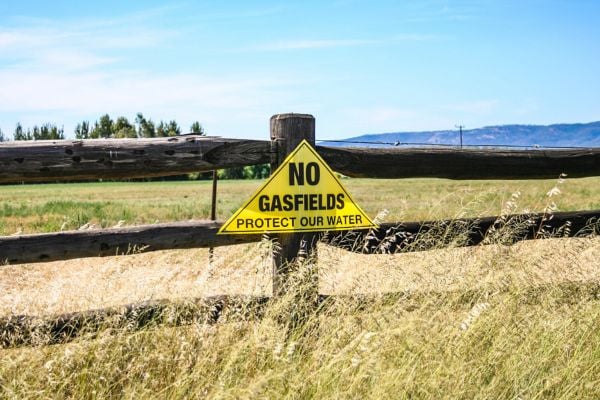
In October, the Alaska Department of Natural Resources decided it’s in the state’s best interest to give a company the right to explore for methane (a.k.a natural gas) in two areas of the largely undisturbed Susitna Valley. The Susitna River and its many entangled tributaries are arteries of the Cook Inlet watershed and support salmon runs of all five species.
In its best-interest finding, DNR expects the Railbelt’s gas demand to remain unchanged, meaning that supply from Cook Inlet will fall short around 2030. “Investment in exploration and delineation of natural gas resources therefore is crucial for the continued security of natural gas supplies,” the document states, finding that “the potential benefits outweigh the possible negative effects” of gas exploration. In our comments, Inletkeeper outlines how DRN underestimates the negative effects.
Reducing our gas dependency will be far more beneficial than feeding it. But without any real plan to do so, DNR’s decision is a prime example of how gas dependence takes us to a future of bad choices and worse ones. After Hilcorp’s 2022 decision to stop offering gas contracts, a working group of the electric utilities and ENSTAR studied gas supply alternatives. The upshot of their investigation is that all our gas options are bad – significantly raising energy prices, creating new dependencies on volatile markets and decision-makers beyond our control, and likely increasing our climate impact as well. Continuing to rely on natural gas does not mean maintaining the same energy system we’ve had for the past half-century. It means slipping into a more expensive, volatile, and destructive one. Potential drilling in Lower Cook Inlet, which would provide little gas at higher prices in addition to endangering a marine ecosystem, is one of the worse choices on the menu. Another is coalbed methane from the Susitna Valley.
Unlike conventional reservoirs where gas is trapped in porous rock, coalbed methane forms in tiny cracks within coal seams. In some cases natural fractures can allow coalbed gas to escape into wells, but formations with less natural porosity, such as the low-quality coal in the Susitna Valley, require hydraulic fracturing – that is, “fracking” by high-pressure injections of water mixed with sand and chemicals – to produce gas. This will entail moving loads of fracking fluid to drill sites and the management of post-fracking waste.
In addition to risking spills and aquifer contamination, fracking adds a substantial cost. Even if some amount of discovered coalbed methane is able to compete with remnant Cook Inlet gas and imported LNG, it will still contribute to the gas dependence that weighs on our economy and cost of life. The cost of this gas to Cook Inlet would be more than financial. Accessing the Susitna Valley for any kind of gas extraction will require building road beds and gravel pads that will change the flow of groundwater into some of the watershed’s more important and most vulnerable stream habitats.
The Deshka River, flowing through the east of the proposed coalbed methane exploration area, is an important habitat for king and coho salmon. It produces about 20% of king escapements for the Susitna River, and is one of the watershed’s fastest-warming streams. During the July 2019 heatwave, Inletkeeper’s stream temperature monitoring showed the Deshka hitting a record temperature for Cook Inlet streams of 80 degrees Fahrenheit. The summer before, its average daily temperature exceeded salmon health criteria on 86% of the days sampled.
As streams warm, groundwater inflows that bring cooler temperatures are increasingly important for the viability of salmon populations. Thermal image studies commissioned by Inletkeeper have shown these “cold water refugia” to be especially important to the salmon runs in the warming Deshka. Restricting or redirecting the shallow, stream-feeding groundwater with gravel pads and road beds for gas development will raise the temperature of the Susitna Valley’s rivers, jeopardizing our salmon.
Coalbed methane from the Susitna Valley is a “solution” we don’t need at a cost we can’t afford. There are impactful and well-researched choices we can make to reduce our gas dependency with wind, solar, and small hydro, but until we take serious steps to do so, we open the door to increasingly expensive and destructive ways to feed our gas addiction.