
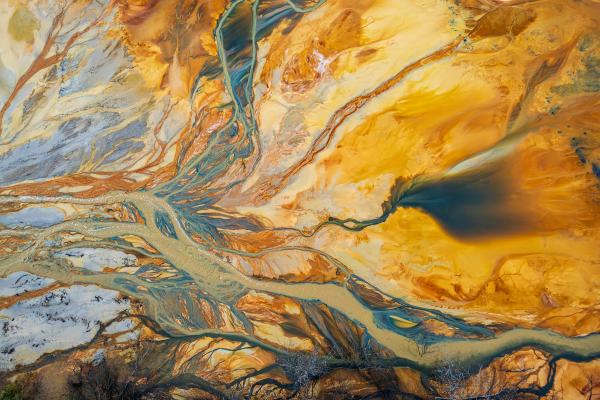
During the early battle of the No Pebble Mine campaign, Earthworks, a national organization working to protect communities from the impacts of extractive economies on health, air, water, and land, made defending Bristol Bay a cornerstone of their No Dirty Gold Campaign. Drawing attention from both the public and the jewelry industry, Earthworks brought into focus just how toxic gold mining can be and alternative sources to fulfill the demand for gold.
Now, as the price of gold teeters around an all-time high, mining companies are looking at Alaska with greedy raven energy. And though shiny and lucrative (for private corporations), gold is still dirty: for every gram of gold mined, approximately 1 ton of waste rock is mined. Whether occurring naturally or added as part of the ore milling process, mine waste pollutes local waterways with lead, arsenic, cyanide, mercury, and other dangerous chemicals and metals, contaminating drinking water and poisoning aquatic life. These contaminants bioaccumulate up the food chain all the way to people. It is estimated that abandoned hardrock mines have contributed to the contamination of 40% of rivers and 50% of all lakes in the United States. Mining is the US’s biggest polluter, and the largest producer of toxic releases in Alaska, according to the Environmental Protection Agency (EPA).
Gold is not worth the harm its extraction causes. It’s not critical to our collective well-being, and its industrial demand is low. Only 8% of the global gold demand is used in industry. The majority of new gold is made into jewelry or stored in underground vaults as an investment. Production rates of the recycled gold industry already produce what is needed and more for gold’s practical applications.
At its current production scale, the recycled market supplies around 25% of the annual gold demand. That’s 100% of the gold needed for consumer electronics, semiconductors, and dental implants, and 45% of the demand for jewelry. Recycled gold generates only 0.33% of the greenhouse gas emissions and consumes 0.26% of the water as gold produced at a mine. This industry has room to grow, and its significantly lesser impact on local watersheds warrants investment in this growth.
This is why, over the last 20 years, Cook Inletkeeper has actively supported the growth of the recycled metals market by hosting electronics recycling events on the Kenai Peninsula. In that time, we have diverted 646,682 pounds of electronics from local landfills, keeping gold and other metals, which are even more critical to industry, in circulation. The threat of dirty gold projects is close to home, and Inletkeeper will continue to be part of the resistance and the solution.
Meanwhile, gold mining threatens our local watersheds. The proposed Johnson Tract Mine, located on the West Side of Cook Inlet, ten miles inland from Tuxedni Bay at the base of Mt. Iliamna, risks the future of a Cook Inlet fishery and a thriving ecotourism economy. This place is special, as a State and Country, we’ve already taken significant steps to acknowledge its importance. The mine would be developed on a CIRI inholding within the boundaries of Lake Clark National Park, and an industrial port would be built in Tuxedni Bay, designated both as critical Cook Inlet Beluga Habitat and as a National Maritime Refuge surrounding Chisik Island, the largest shorebird colony in Cook Inlet. This region is part of Cook Inlet’s wild bear coast, one of the largest concentrations of brown bears in the world, supporting a robust bear viewing economy. This is no place for a mine.
Once again, we say No to Dirty Gold. Inletkeeper will continue to sound the alarm when there are opportunities to act against these dirty projects. In the meantime, join us in putting downward pressure on mining by recycling your electronics this spring. Healthy lands, waters, wildlife, and people will always be more precious than gold.