
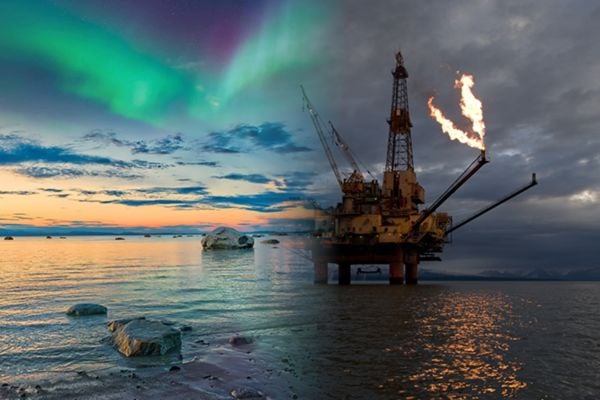
As the Cook Inlet gas we’ve historically relied on for heat and electricity becomes more expensive and precarious, the Trump administration is offering a golden chance to prolong our dependence, spend more on energy, and create a long-term drag on our economy by doubling down on what isn’t working. What’s the price of this opportunity? Only a 1-in-5 risk of major oil spills, which increases with each new piece of extraction infrastructure. The art of the deal!
Not interested? Well, it’s your lucky day. BOEM is signing you up anyway.
With Southcentral’s recent cold snap raising fears of gas shortages again, it’s time for Alaska to make long-term plans for its energy sources, and diversify with renewables. The region’s uncertainty around its energy future is not a new problem, nor are the short-sighted solutions that hinge on simply producing more gas. The reality is Cook Inlet gas supplies are growing more expensive and less available, with primary producer Hilcorp telling utilities they won’t be able to meet demand beyond the next few years. For Alaskans, that likely means higher rates as local utilities try to find ways to rapidly meet demand for natural gas.
After an influx of federal investment in renewable energy projects and climate adaptation under President Biden’s Inflation Reduction Act, the Trump administration is now pushing a regressive fossil fuel agenda that won’t benefit Alaskans. The administration is planning a raft of new offshore leases in Lower Cook Inlet — six mandated in the budget bill, and five proposed in a draft 5-year plan for federal waters. But offshore development is a costly, slow, and environmentally risky approach that won’t alleviate Southcentral’s energy crisis.
Today, the railbelt relies heavily on natural gas, with around 80 percent of Southcentral’s energy currently generated by natural gas turbines. Yet that dependence doesn’t change the reality that the region’s anticipated gas shortfall cannot be met by more drilling in Cook Inlet. Nearshore gas production in Upper Cook Inlet has been falling for years, with Hilcorp declining to renew utility contracts. Another driller, BlueCrest Energy, recently defaulted on its state lease because its investors couldn’t meet the high cost of working in Cook Inlet without state subsidies.
Drilling even farther offshore, beyond the existing pipeline infrastructure, will be far more costly. It will not give us cheap gas. If drillers make the investment at all, it will not give us very much gas – nor give it anytime soon. The Bureau of Ocean Energy Management (BOEM) is the federal agency in charge of the next five years of offshore oil and gas planning. In their analysis, gas that could be economically extracted from Lower Cook Inlet would meet roughly five years of Southcentral’s demand. This depends on the assumption that oil prices — which forecasters expect to remain near $65/barrel range for the next few years — are $160/barrel, a price historically reached only for brief periods of geopolitical crisis. The 2022 work that BOEM is basing its current analysis on suggests that to get any significant amount of gas from the Lower Inlet, prices would need to go much higher. This hypothetical gas wouldn’t arrive soon at any price. It can take a decade or more for an oil company to go from bidding on a lease to production.
For our communities, the Trump administration’s plan to offer Lower Cook Inlet to oil and gas is a lose-lose proposition: expose our fisheries and ecosystems to a 1-in-5 chance of major oil spills in return for higher energy prices. Those spill odds are from BOEM’s official estimates for 2022’s offshore Lease Sale 258. That’s a bet Alaska can’t afford to make. A spill would be devastating to commercial, charter, subsistence fisheries and to our robust outdoors-oriented tourism industry.
Even if a worst-case spill scenario doesn’t happen, there will be consequences all along the way. Offshore drilling, in any context, releases large quantities of toxins into the marine environment. Seismic blasting harms whales, including critically endangered Cook Inlet belugas by hampering their ability to hunt and communicate. And building oil platforms in prime fishing areas poses hazards for the drift fleet as they tow nets in the Inlet’s notoriously rough waters.
Ultimately, the natural gas crunch now facing Southcentral is not a surprise, but it’s being used as an excuse to make more bad decisions. Now is the time to speak up for Alaska’s energy future that’s rational. One bad decision would be an LNG pipeline, which wouldn’t benefit Alaskans. Another is extensive offshore oil and gas leasing that isn’t viable environmentally or economically. Support a transition to proven wind and solar technologies that are affordable and efficient now. Say no to the nonsense.
You can have a say in what happens next by submitting public comments on BOEM’s offshore plan here. We have talking points and comment suggestions to make that easier too. They are only open until this Friday, January 23rd, at 7:59 pm AK.