
For 30 years, Cook Inletkeeper has been steadfast in standing against corporate greed and the extraction of our lands and waters at the cost of clean water, healthy habitat and sustainable economies. It is an arduous, cyclical, and uphill battle that will continue as long as capitalism reigns and the State of Alaska is willing to give away public resources without holding corporations accountable for preventing pollution and paying their fair share. This work — holding the line for clean water and healthy habitat — remains a cornerstone of our efforts, but climate change is already reshaping life in Alaska.
That’s why, alongside resistance, we build. We take community wellbeing into our own hands and leverage our collective power to create better systems–ones that support resilient, climate-conscious communities. We do this through volunteer leadership, microcosms of democracy, collaboration with local partners and decision-makers, and a shared commitment to making where we live a better place.
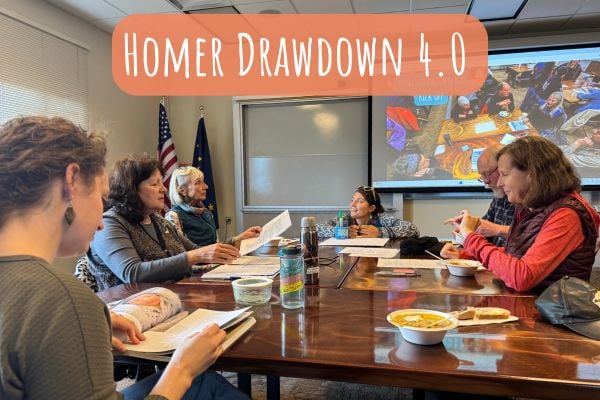
In Homer, we call this community of climate activists Homer Drawdown. We draw inspiration and guidance from Project Drawdown, a global nonprofit that identifies, ranks, and promotes the most effective, scalable solutions to reverse global warming. The group has grown and sustained itself because, at their core, climate solutions make our lives better—our communities safer, more livable, and more affordable. Working toward that future together generates hope and fulfillment.
Now, as Homer Drawdown prepares to launch our fourth solution in the near year, we are forging ahead with a new focus: local waste streams. Project Drawdown identifies waste as a major climate opportunity because everything we use and throw away carries a trail of wasted energy, land, water, and emissions across its lifecycle. The biggest climate gains come from consuming less and treating waste as a resource rather than an endpoint. Reducing food waste in particular is one of the highest-impact climate solutions. Roughly one-third of food is wasted globally, and likewise, organic material makes up about a third of what ends up in our local landfill. Think about what it takes to get food to your fork. A third of all that land, water, energy, and human effort is for nothing, it’s staggeringly wasteful.
Beyond the climate benefits, reducing waste offers powerful co-benefits: extending the life of our landfill, stimulating new local economies, saving money, and feeding people in our community who need it.
Our work will evolve as we plan and organize in the new year, but our aspirations are high. When we gather again in January, we will form working groups to move ideas into action, including:
- Hosting a community forum on the state of the landfill, recycling, composting, and waste-reduction goals
- Working with the borough and potential contractors to explore and work towards implementing municipal composting in Homer
- Increasing local recycling rates and helping businesses improve recycling practices
- Subsidizing restaurant-scale glass crushers
- Expanding recycling education in schools
- Creating clear, artful sorting signage at transfer sites
- Volunteering to help sort recyclable materials
- Establishing plastic film recycling in boat yards in the spring
- Expanding use of Homer’s Buy Nothing Facebook group
- Hosting workshops to build skills around reducing food waste, including:
-
- Gathering and preserving wild foods
- Canning, pickling, and fermenting
- Using the whole fish
- Composting at home
- Minimizing household food waste
- Creating a directory to connect food and organic waste producers with those who can use them
- Installing signage and sharing resources at fish-processing stations to help anglers and dipnetters maximize their catch
- Working with restaurants to rescue leftover food and divert it to the free fridge
In a time when so many decisions are made far from the people they affect, Cook Inletkeeper remains rooted in community, accountability, and hope. Your support allows us to keep organizing, advocating, and building solutions that make life in Alaska more sustainable and resilient — today and for generations to come. If this vision resonates with you, please consider making a donation — and if you’re in the Homer area, consider getting involved with Homer Drawdown, it takes a village.