Science on the Little Su: Protecting Groundwater Connections for Mat-Su Basin Salmon Habitat Resilience

by | Nov 17, 2025 | Clean Water, Climate Change, Salmon

The Little Susitna supports Chinook and Coho runs that are central to local economies, subsistence traditions, and the health of our watershed. By mapping these critical cold spots, we can help ensure that healthy habitat is protected and guide conservation efforts in the face of climate change and increasing development pressure.

Thanks to your support, Inletkeeper will be launching a new science project on the Little Susitna River in summer 2026. The Little Susitna has been identified by regional partners as a top priority watershed for managing salmon habitats and as one of the most productive salmon fisheries in the Mat-Su region. The Little Susitna supports Chinook and Coho runs that are central to local economies, subsistence traditions, and the health of our watershed. But it is also one of the warmest rivers in the basin, and rising summer stream temperatures are creating real challenges for migrating salmon.

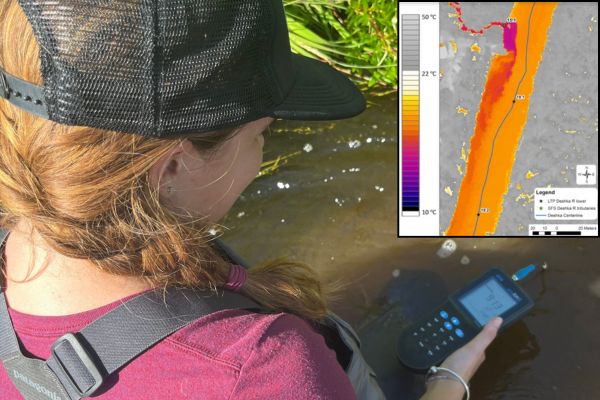
This coming summer, Inletkeeper will conduct aerial thermal imaging along 25 miles of the lower Little Susitna to identify hidden groundwater inflows— cool-water refuges that salmon use to rest and recover during their upstream migration. By mapping these critical cold spots, we can help ensure that healthy habitat is protected; guiding conservation efforts in the face of climate change and increasing development pressure.

The project builds on earlier thermal imagery collected in the Big Lake and Deshka River watersheds, expanding our understanding of where groundwater and surface water interact to sustain fish. The resulting high-resolution maps will be made publicly available and shared with partners including Alaska Department of Fish & Game, the Mat-Su Borough, and local land trusts. These tools will inform land-use planning, outreach to landowners, and conservation strategies designed to keep cold, clean water flowing where salmon need it most.

This is the type of work your generosity makes possible. By investing in science today, you are helping build the knowledge and partnerships needed to safeguard salmon habitat for generations to come. As Inletkeeper continues to champion science-based solutions, we are grateful for your role in helping us attain the match to make this research—and the future it protects—possible.

Similar Posts

The “Big, Beautiful Cook Inlet” (BBC1): March Lease Sales Move Forward without New Environmental Reviews

Instead of conducting updated environmental analysis, on the BBC1 lease sale the administration indicated it would rely on reviews completed in 2017 during the first Trump administration. Inletkeeper has joined with community and environmental groups to formally notify Interior Secretary Doug Burgum of their intent to sue if the sale proceeds without required consultation under the Endangered Species Act (ESA). Relying on outdated reports disregards nearly a decade worth of analysis on the accelerating impacts of climate change, increased industrial activity, and updated science on species and habitat conditions.

What’s Next for Planned Offshore Lease Sales in Lower Cook Inlet

Last year, the Bureau of Ocean Energy Management (BOEM) prematurely scrapped an offshore management plan that protected Alaskan coastal waters from oil and gas leasing. Now, the agency is planning multiple leases for Lower Cook Inlet in their new 5-year plan. It’s vital that we continue to speak up for our coastal ecosystems, sustainable fisheries, and what’s best for our local economies. Learn what happens next.

We can’t risk turning climate pollution into water pollution

Carbon capture has a host of uncertainties upstream of the injection well. But let’s set aside for now the unsolved technological question of how CO2 can be affordably captured at any significant scale. Likewise the economic and political questions of how to price and/or police carbon to make polluters capture it. What concerns do we have about pumping CO2 underground, and the vigilance needed to be sure it doesn’t harm the people and ecosystems above?