
The proposed Johnson Tract Mine is presented as an economic opportunity for Alaska, but the company’s 2025 SEC Initial Assessment makes one thing clear: this is a short-term gold project that rewards outside investors, while providing limited returns for Cook Inlet Region, Inc. (CIRI) and posing real environmental risks for the region.
A recent economic evaluation by independent mining expert, Beach Meadows Resources, closely examined the mine’s Initial Assessment. The findings highlight how small CIRI’s guaranteed share from the mine would be if it moves into construction and production.
The report shows that at a gold price of $2,200 per ounce, the mine is expected to generate about $510 million in pre-tax profits over a seven-year period. Approximately 70% of that revenue would come from gold. The price per ounce may seem low compared to today’s market, but it is common in mine finance to use a gold price below current market levels when estimating profitability. It is impossible to predict what gold will trade for years from now when production would start, and conservative pricing helps offset the typical industry experience that construction costs often exceed initial estimates. Even with that safety margin, the project’s success ultimately hinges on volatile global gold markets.
Under the lease agreement with the mining company, CIRI is guaranteed to receive 10% of the mine’s profits in royalties, roughly $50 million at a gold price of $2,200. However, under ANCSA’s mandatory revenue-sharing provisions, CIRI must distribute 70% of those resource revenues to all regional Native corporations. Taking that into account, our rough estimate of the remaining 30% suggests CIRI would be guaranteed to retain only about $15 million over the full seven-year mine lifespan, averaging just over $2 million annually.
To put that into perspective, CIRI is a billion-dollar diversified corporation with investments in energy, real estate, government contracting, and private equity. In strong years, CIRI’s revenues have reached hundreds of millions of dollars. While $2 million may seem like a lot to most people, it does not significantly affect CIRI’s balance sheet, dividend capacity, or long-term strategic plans. Even if gold sells closer to today’s prices and we double that amount, $30 million over seven years is still not a hugely significant amount of money.
Meanwhile, the largest share of projected profit, around $335 million based on the $2,200 gold price, would mostly flow outside of Alaska to Contango Ore and its shareholders, including some of the biggest and most carbon-intensive hedge and index fund managers in the world, such as Vanguard and BlackRock. Like many other extractive projects in Alaska, the wealth generated by this mine would be concentrated in national and global capital markets rather than in nearby communities.
The mine itself is currently planned to operate for only seven productive years, with peak production in the first three years and a peak workforce of about 170 people. This scale does not create a stable regional economy. It does not provide long-term employment across generations. It is a short-term extraction cycle tied to gold prices that no one can reliably predict.
CIRI has a one-time option to buy a 25% ownership stake in the project. Exercising this option could boost potential returns, but it would also require CIRI to cover 25% of the capital and operating costs, currently estimated at over $750 million combined, and are subject to significant uncertainty. Mining projects often go over initial cost estimates. Gold prices fluctuate. Taking on this option would expose CIRI to significant financial risk.
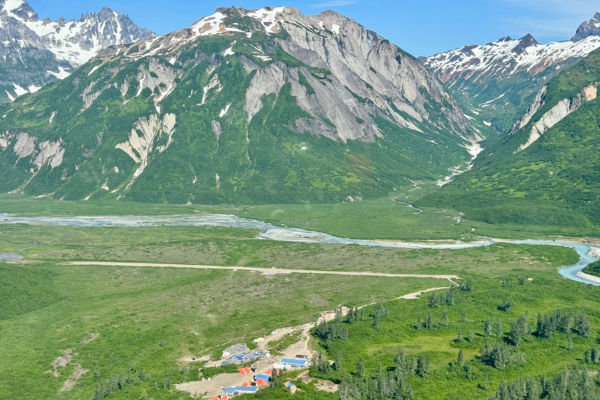
What remains certain are the impacts. The project requires industrial roads, a port facility, diesel power generation, waste rock storage, a water treatment plant, and nearly year-round ore shipments. Industrial activity would expand into public lands known for bear viewing, sport and commercial fishing, and rich razor clam beds, the bedrock of local economies that can be sustained for many lifetimes, long surpassing the lifespan of the Johnson Tract gold mine.
The mine can likely make a profit with high gold prices. The real question is whether a seven-year gold project that guarantees only 10% of its profits to CIRI is worth the long-term environmental and community trade-offs.
For a corporation of CIRI’s size, this is not a financial necessity. The region’s fisheries, critically endangered belugas, and tourism economy face far greater stakes. Gold can only be extracted once, but the living wealth of the stunning, intact ecosystems of Tuxedni Bay and the Johnson River can sustain hearts, bellies, and livelihoods for generations.