
In my early years learning about the ecology of streams, I spent a few summers in the sagebrush country of southeastern Oregon. I was studying desert springs measuring water chemistry, collecting bugs and identifying plants associated with each little oasis. I was discovering the complex connections of the natural world at a very micro-scale.
I also learned an important lesson that informs our work today: you have to recognize the larger systems at play to understand the landscape in front of you.
One day I was driving across a vast tract of our public lands in the company of a good field assistant when this painful lesson hit me. As we arrived back at a spring we had sampled the day before, we found total devastation: a herd of cows had trampled the spring, gobbled-up the vegetation and wallowed in the water. The spring and my research questions were never the same.
Now, this isn’t a cow bashing story. It’s a story about how history and outdated laws shape our natural systems today. In this case, it’s about the open range laws of the West. Livestock grazing on public lands dates back to the 1800s, when influential cattle barons secured the rights to let their herds roam our public lands freely. So, it was perfectly legal for these cows to plow through and plop down in the middle of a delicate spring system on this particular landscape, regardless of the impact.
Many years later I am still studying springs and how these cold-water habitats support Alaska’s salmon in our warming world.
And the story holds true here in Alaska as well. For example, in Cook Inlet, the oil and gas industry can use “mixing zones” to dump its production wastes into our fisheries. Mixing zones embrace the outdated and false notion that dilution is the solution to pollution. Similar to the cattle barons of yore, the oil and gas industry, with its long grip on our political system, can use our public waters as its private dumping grounds.
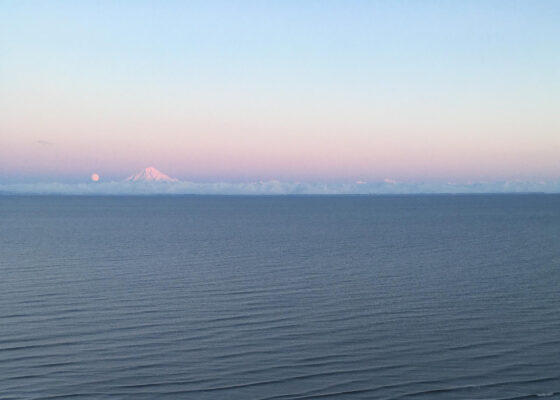
At Inletkeeper, we’re thinking deeply about the outside forces that influence our ability to be effective locally. For the last 25 years, we’ve had a very ambitious goal of protecting the Cook Inlet watershed – a spectacular ecosystem covering 47,000 square miles of Southcentral Alaska. Obviously, with a watershed that size, we think big; however, we’re thinking about even larger systems now. We’re examining the communications, corporate, food, energy and social justice systems that work for and mostly against us as we endeavor to protect what we love.
Please join us – and a growing movement of activists, community leaders, scientists and artists – as we reimagine how our oceans and landscapes can and must reflect not only our past but our desired future.
Yours for Cook Inlet,
Sue Mauger
Science & Executive Director