
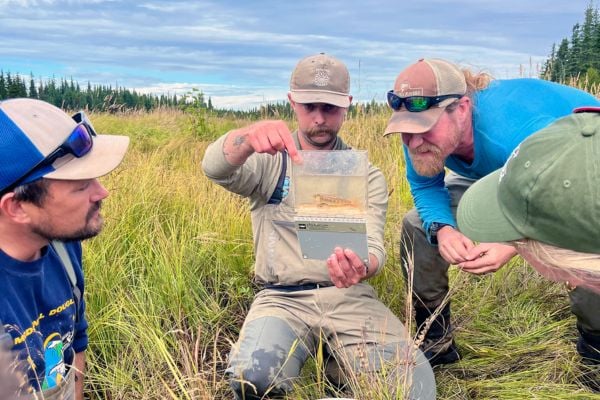
They say fish live in beautiful places, and as an avid fisherman, I’ve waded in what I consider the most beautiful waters in the world here in the Cook Inlet watershed. I’ve chased every species of salmon that call these special waters home. However, after teaming up with the Kenai Watershed Forum (KWF) for Salmon Habitat Mapping field days—a program designed to engage volunteers in documenting local, unmapped salmon habitats as part of Inletkeeper’s Local Solutions series—I can now say that fish also live in unexpected places.
During one of the mapping field days in August, one of our young volunteers captured a surprise: a Dallia pectoralis, or Alaska Blackfish; native to Alaska but considered invasive on the Kenai Peninsula. A sharp-eyed 6-year-old volunteer spotted the hardy Alaskan fish on the bank of a small, bog-like tributary. It went unnoticed by all the other volunteers because it was tossed from the minnow trap, which appeared to the adult eye to contain only an orange sludge-like mud. The discovery sent a wave of excitement through the team of volunteers. It wasn’t the species we were hoping to find, but it showed that even in the unlikeliest of environments, fish can be found. That day, in the most unassuming stream, we didn’t just find a unique aquatic vertebrate—we found connection and a shared passion to protect Cook Inlet’s life-sustaining habitats.
Inletkeeper’s collaboration with KWF brought together nearly 40 volunteers over the summer for four Salmon Habitat Mapping field days. Together, our teams identified overlooked waters, learning about salmon habitat mapping and participating in hands-on work to identify and document unmapped bodies of water. Their efforts contribute to increasing the number of streams and rivers protected by the State’s Anadromous Waters Catalog. Inletkeeper’s Salmon Solution program depends on strong, diverse volunteer-based collaboration. We invite our local community members, both young and old, to be a part of bringing this initiative to life. Our work empowers our communities through engagement, education, and training, while striving toward a goal of connecting to place and becoming active stewards of the watershed. Protecting salmon requires more than policy—it requires people to connect with a place, and to take action on its behalf.
Looking ahead, Inletkeeper will host monthly gatherings at the Community Action Studio in Soldotna, in preparation for next year’s scaled-up Salmon Habit Solution work. Join us to learn more about the solution and how you can be part of safeguarding salmon habitat for generations to come.