
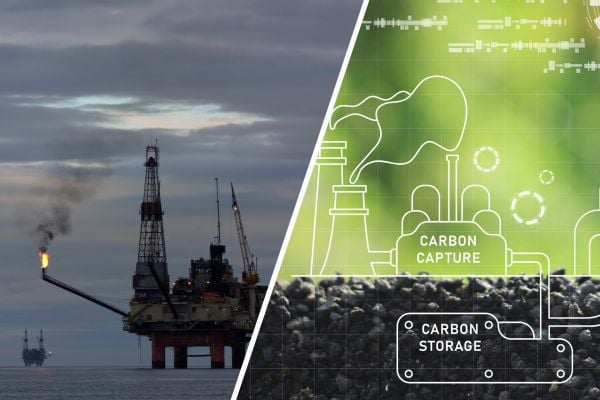
Climate activists have a simple imperative as our goal: “Keep it in the ground!” It being fossil fuels and the climate-damaging carbon pollution they become when burnt. But oil and gas drillers aren’t keeping their product in the ground. As global carbon emissions and temperatures continue to rise, there’s been a parallel wave of advocacy to “put it back in the ground.”
Geological carbon storage entails capturing carbon dioxide – from the air, from the exhaust of powerplants or industrial facilities – piping it to injection wells, and pumping it underground, where it’s intended to remain indefinitely.
The Alaska Oil and Gas Conservation Commission (AOGCC) is seeking oversight of this last step– injecting CO2 at supercritical pressure into sealed, porous rock formations, then monitoring it to be sure it stays trapped there. In October, AOGCC put out draft regulations for overseeing “Class IV” carbon injection wells, a responsibility it wants to take over from the federal Environmental Protection Agency.
Carbon capture has a host of uncertainties upstream of the injection well. But let’s set aside for now the unsolved technological question of how CO2 can be affordably captured at any significant scale. Likewise the economic and political questions of how to price and/or police carbon to make polluters capture it. What concerns do we have about pumping CO2 underground, and the vigilance needed to be sure it doesn’t harm the people and ecosystems above?
These questions matter especially to Cook Inlet. If carbon injection becomes the industry its Alaskan boosters fantasize about, our watershed will once again be the front line. Researchers estimate Cook Inlet basin houses 87% of Alaska’s potential capacity in fractured coal seams.
If you’ve ever left a water glass sitting overnight and found it bitter to drink in the morning, you’ve discovered that CO2 (in this case from the air) dissolves into water and reacts to form carbonic acid. In carbonated soda water, CO2 and the resulting carbonic acid add extra zing to your seltzer. But when ground water mixes with millions or billions of tonnes of CO2 injected at supercritical pressures, the acidified water can leach metals and minerals that contaminate the watershed.
Keeping CO2 away from groundwater flows is essential. Injection reservoirs can’t be exposed to geological faults or old, badly plugged wells. They need constant monitoring to be sure gas isn’t leaking into other geological formations.
CO2 that forms naturally alongside oil and gas is a non-combustable and corrosive contaminant that drillers need to separate before sending the valuable hydrocarbons to market. For many years, it’s been a standard oilfield practice to pump this CO2 back underground to re-pressurize the reservoir and increase production. This is called “enhanced oil recovery,” and it’s different in purpose and technique than the newer practice of injecting waste CO2 to keep it out of the atmosphere. The EPA permits injection wells for enhanced oil recovery under the category of “Class II” wells, which AOGCC presently has permitting authority over.
AOGCC’s proposed rules for Class VI wells allow too much discretion for operators to re-designate existing Class II wells as Class VI. Though AOGCC won’t give Class VI wells exemptions from aquifer protection rules, their draft rules create a backdoor by allowing existing aquifer exemptions from Class II wells to be expanded into new areas affected by injected CO2.
For a new practice with more complex safety risks than traditional activities, AOGCC should not be the agency of choice for protecting our land and water, especially as severe questions of budget adequacy loom over the state. Since the Class VI well designation was created in 2011, the EPA has permitted four Class VI wells. The three states that presently have Class VI permitting primacy (North Dakota, Wyoming, and Louissiana) have an additional five. The nation’s first Class VI injection facility, used by Archer Midland Daniels to inject CO2 produced by an ethanol plant in Illinois, only came online in 2017. By 2023, a well was leaking due to the type of steel used in its casing. For a technology meant to store carbon underground forever, we don’t have a good understanding of its failure modes. Alaska shouldn’t be the laboratory, and AOGCC shouldn’t experiment.
Locking climate pollution underground may one day be a benefit – but only if we can be sure it never becomes water pollution. The cost and complexity of properly regulating carbon injection means Alaska is better off leaving it to the EPA.
In the long run, we need to somehow remove centuries worth of past carbon dioxide emissions from our atmosphere. The only sane way to begin is to stop spewing more. Keep it in the ground.